[caption id="attachment_2710" align="alignnone" width="300"] Learn more about business registration, trademark registration, compliance and get updated with valuable business insights with TMWala Blog Posts.[/caption]
FSSAI registration is a mandatory requirement for anyone involved in the food business, including manufacturers, processors, distributors, retailers, and even home-based sellers. In simple terms, it’s a certification that shows you meet the food safety standards set by the Indian government. The FSSAI license number, which you will receive once your registration is complete, must be displayed on your food packaging, menus, and marketing materials. This shows customers that you follow strict food safety protocols.
If you’re planning to start a food business in India, obtaining an FSSAI registration is essential. FSSAI (Food Safety and Standards Authority of India) ensures that food products meet safety standards, protecting consumer health. Whether you’re applying for an FSSAI registration online, obtaining an FSSAI food license, or understanding the FSSAI certificate process, TMWala has got you covered!
Learn more about FSSAI License through our website on by clicking here.
FSSAI registration is mandatory for all food-related businesses in India, from small retailers to large manufacturers. There are different types of FSSAI licenses: Basic License, State License, and Central License. Depending on the scale of your business, you’ll need to choose the appropriate one. For small businesses or startups, a Basic FSSAI registration is sufficient, while larger establishments may require a State or Central FSSAI license. Each comes with its own eligibility criteria and cost, which can be checked on the official FSSAI website.
There are different types of FSSAI registrations based on the size and nature of your business. If you’re a small-scale business, you may only need basic registration. Medium-sized businesses may require a State License, while large-scale operations will need a Central License. It might sound a bit overwhelming, but we’ll break it down to help you figure out which one fits your business needs. The good news is that once you have this registration in place, it’s like a stamp of approval from the government, letting people know that your food is safe and high quality.
Importance of FSSAI Registration
FSSAI registration also provides you with legal protection. Operating without it can lead to heavy fines and penalties, not to mention the risk of being shut down by authorities. You wouldn’t want that after pouring your heart into your food business! So, think of FSSAI registration as a safety net that protects you from legal hassles and helps you run your business smoothly.
FSSAI registration ensures that your business complies with food safety laws in India, creating trust with consumers. It is compulsory for anyone in the food business, whether you’re a street vendor, restaurant owner, or packaged food manufacturer. Not only does FSSAI licensing help maintain quality standards, but it also ensures that your food products are safe for consumption. Failure to obtain an FSSAI food license can result in penalties and legal action.
Moreover, FSSAI certification provides credibility to your food business, helping you build a reputation for offering safe and hygienic products. Customers are more likely to trust businesses that display their FSSAI certificate, making it an essential part of your business strategy.
Lastly, FSSAI registration can help you expand your business. If you’re looking to sell your products through bigger channels like supermarkets, restaurants, or even online platforms, having FSSAI registration is often a requirement. It can also make it easier to access loans or government schemes that support food businesses. In short, FSSAI registration is like the golden ticket for growth!
Process of Getting FSSAI Registered
Applying for FSSAI registration online is generally a straightforward process. First, identify which license you need – Basic License, State, or Central. The FSSAI online application process is designed to be user-friendly. You can apply for an FSSAI license online through the FSSAI website by filling in the necessary details and uploading the required documents for FSSAI registration, such as proof of address, photo ID, and details about your food business, details of which are given below.
Detailed instructions & Step-by-Step Process to apply for FSSAI registration
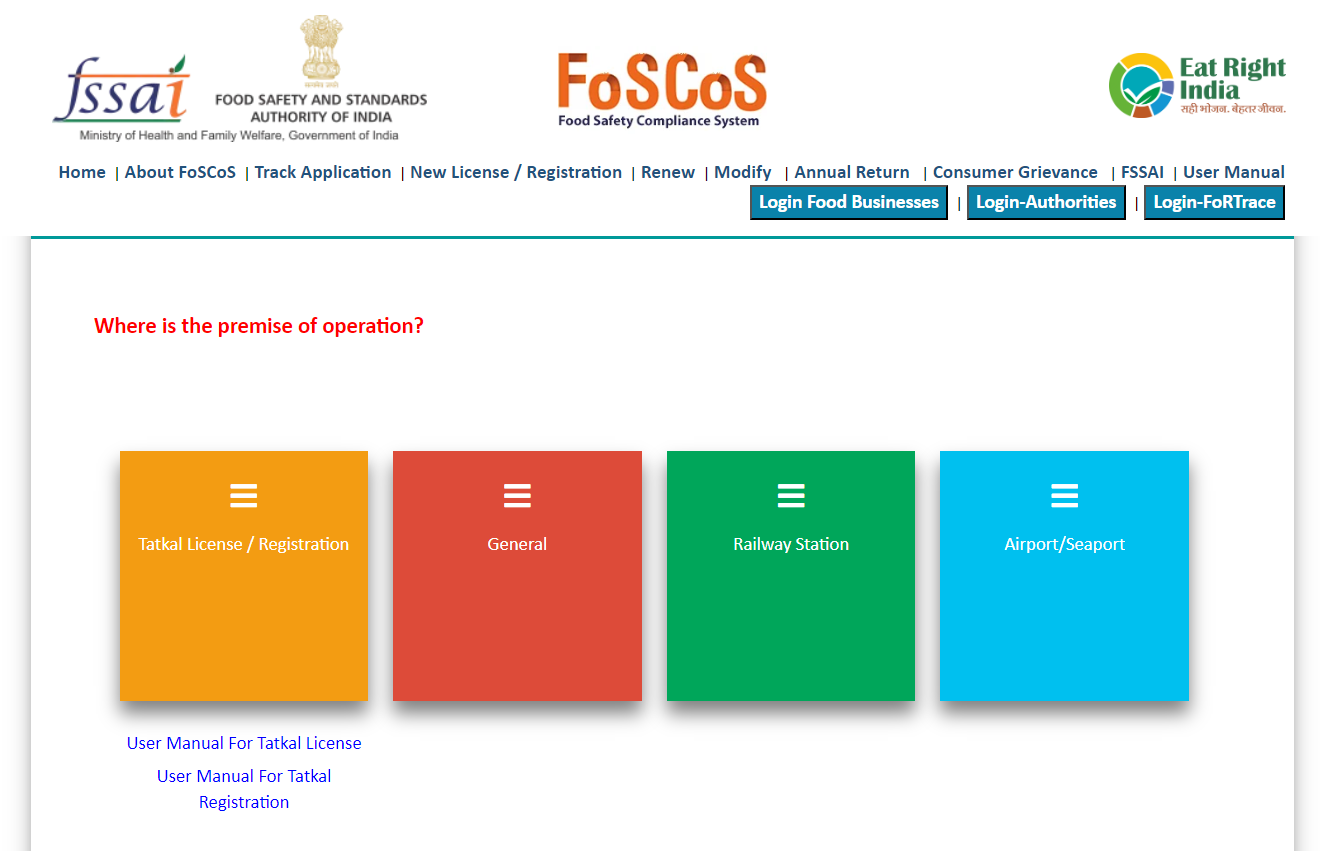
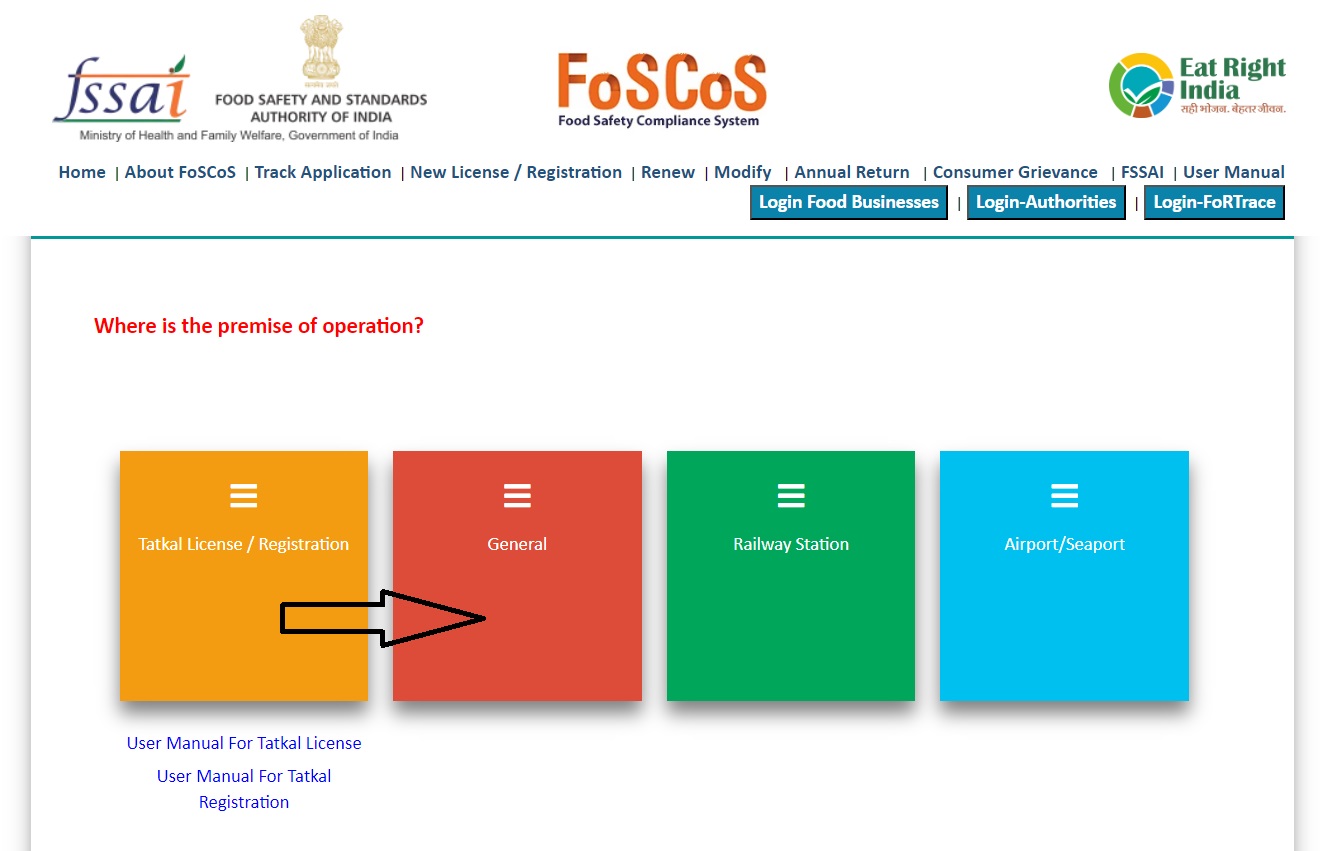
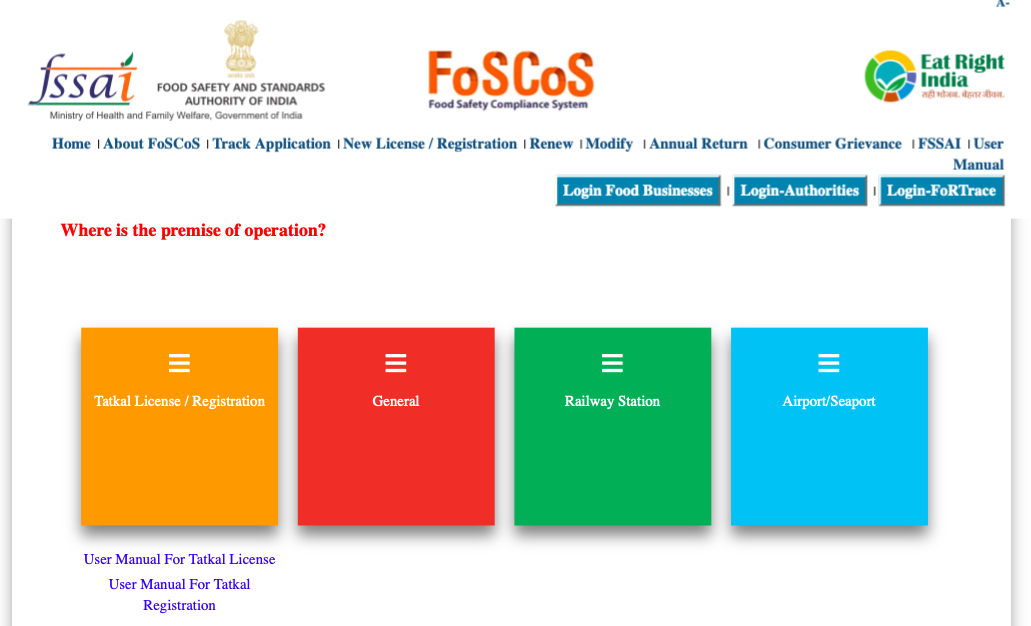
Step 2 : Go to the red box and click on the “general button”.
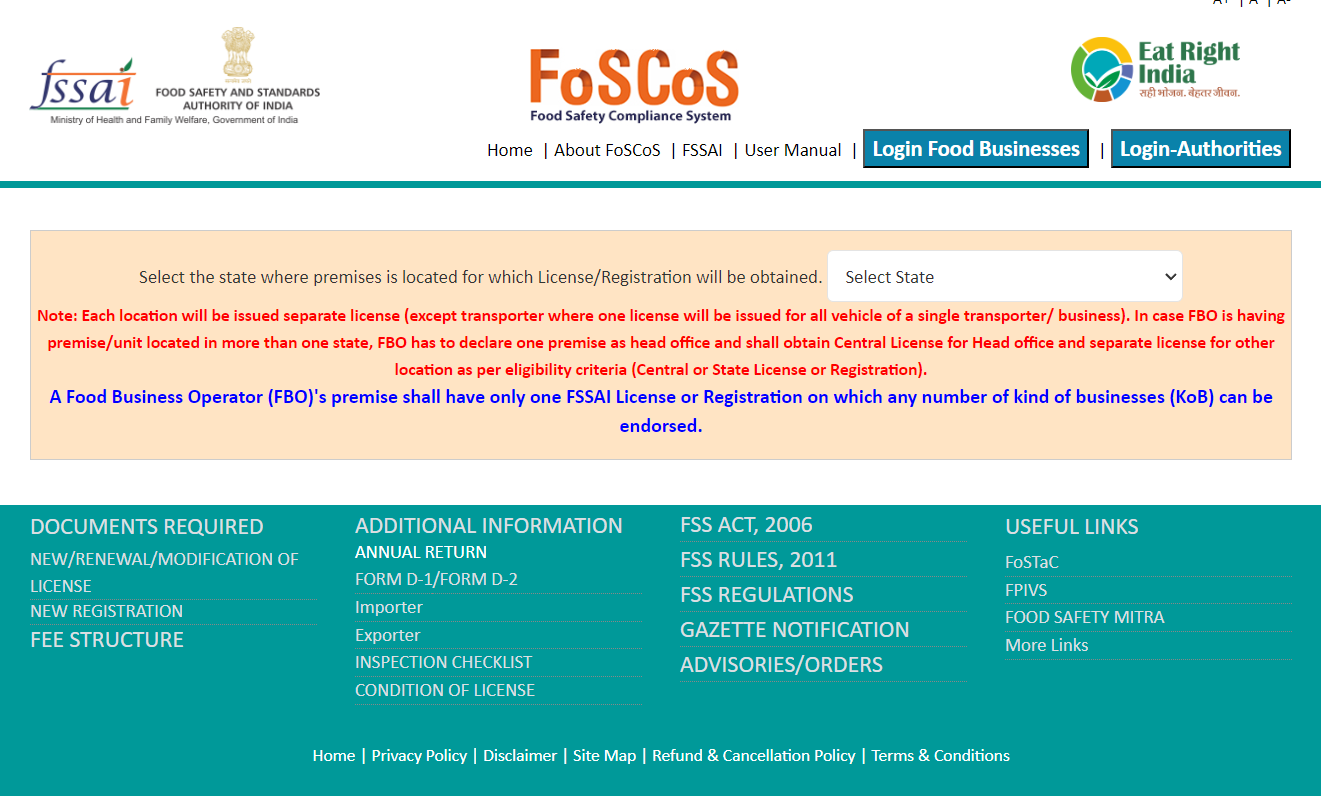
Step 3 : Select the “ State” where the business premise is located and proceed.
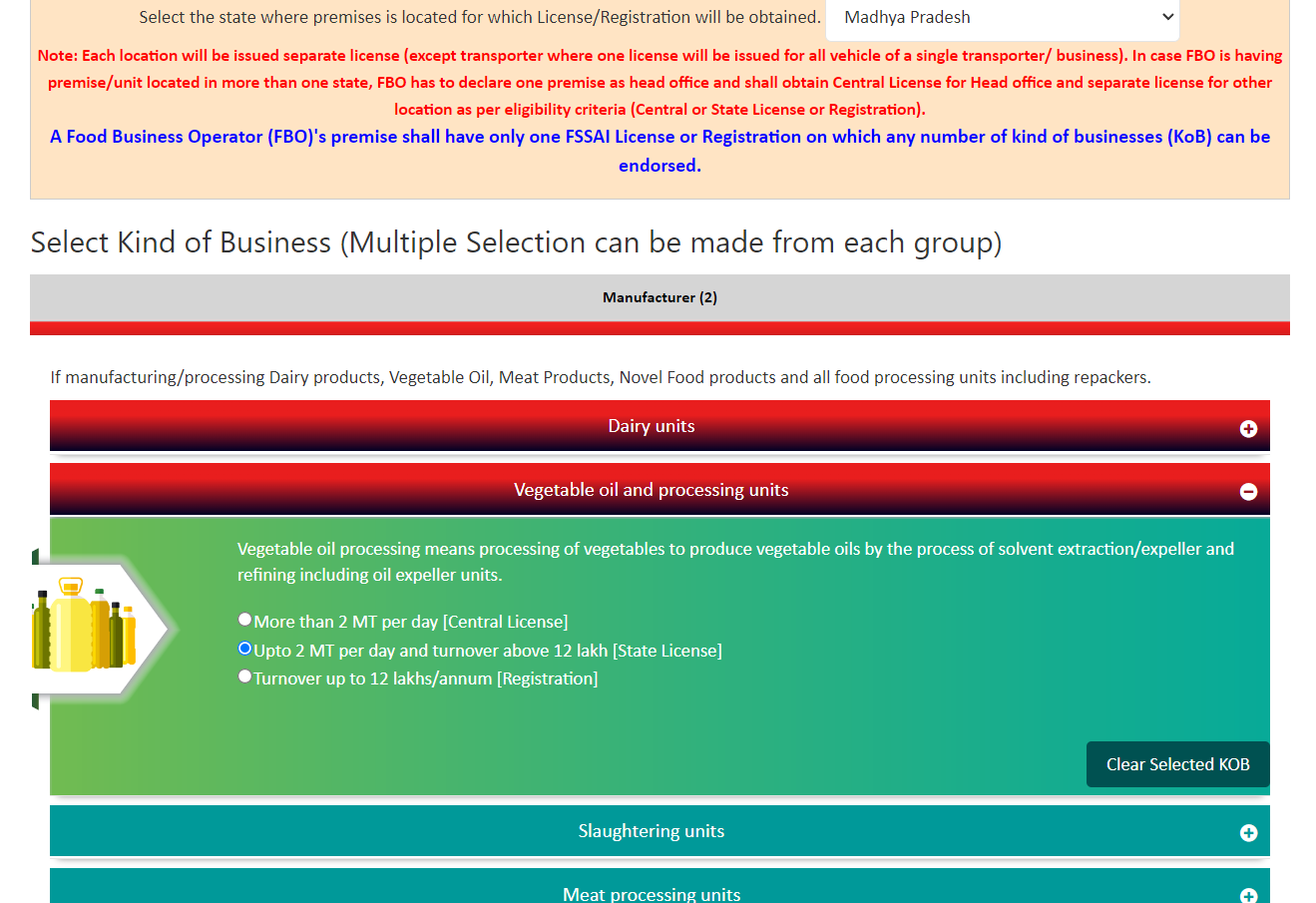
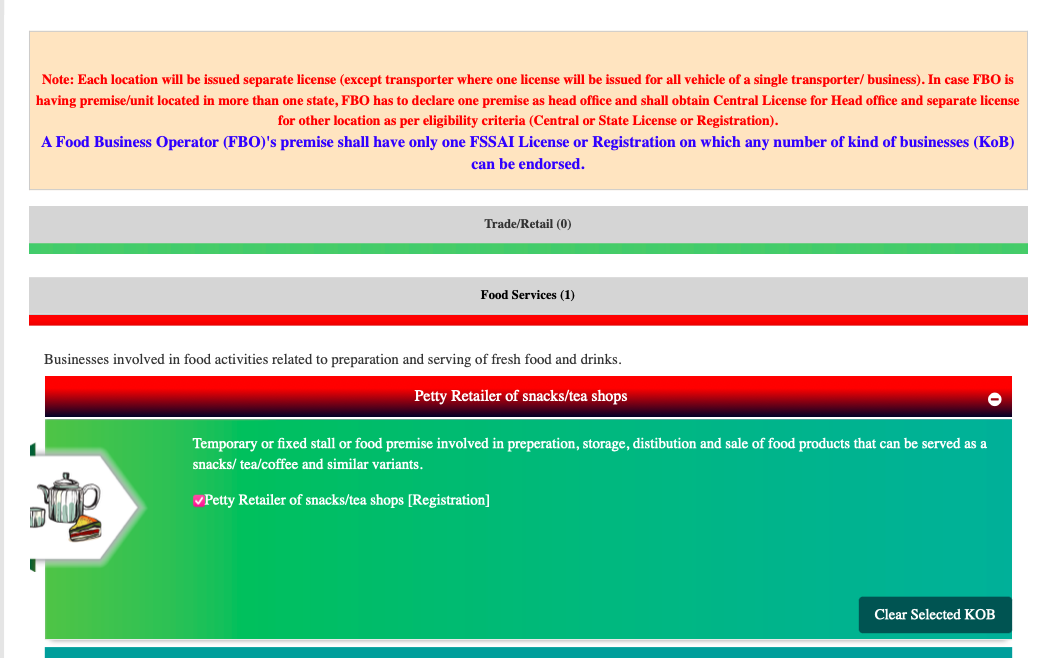
Step 4: Select the Kind of Business [KoB] – as applicable. [Read Definitions before making
E.g General manufacturing KoB Under “ Manufacturer” Head
Read the eligibility criteria and select the appropriate option (deciding criteria between central license, state license and registration ) and click on Proceed .
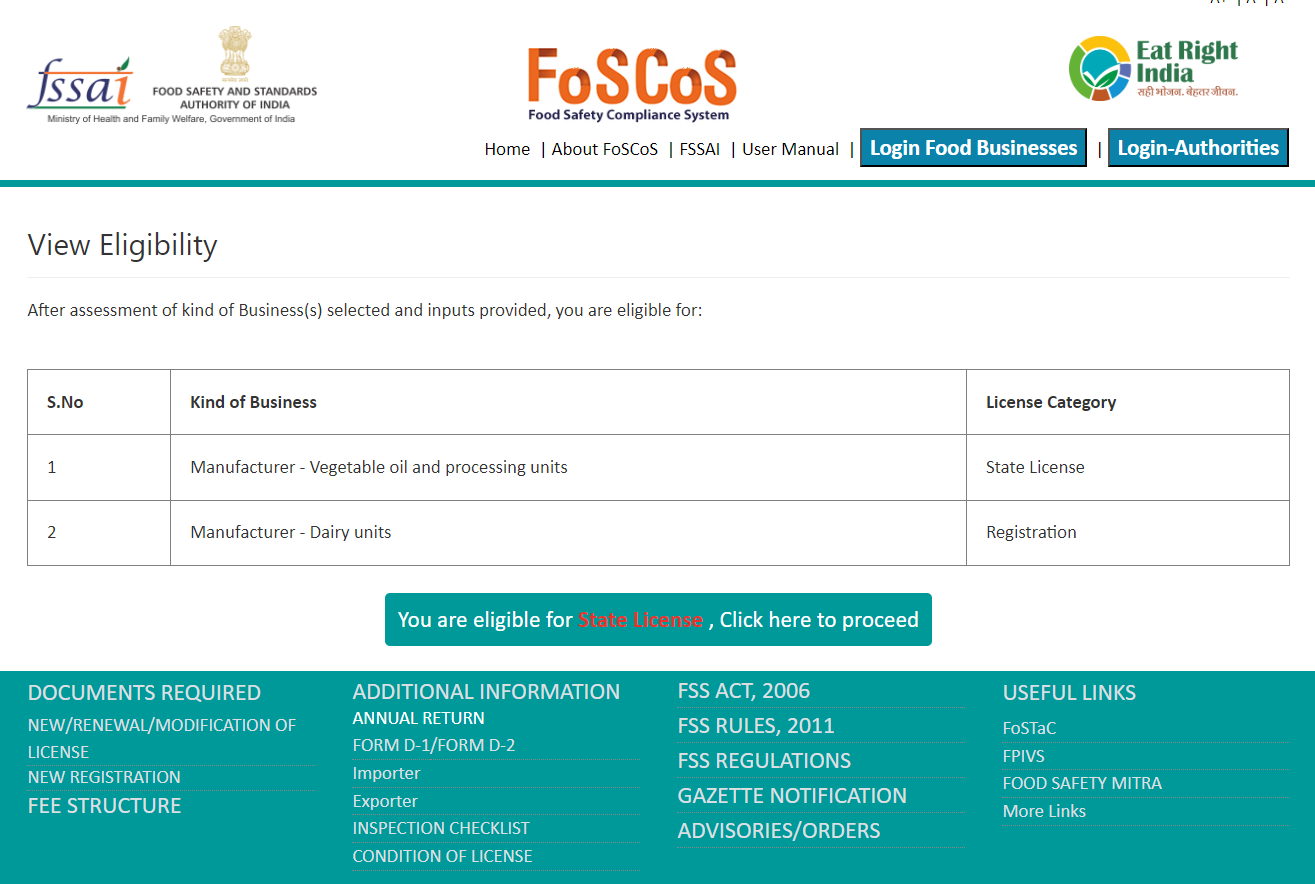
Step 5 : System will assess the Eligibility Criteria. Proceed further by clicking “Click here to apply for Central/State license for all businesses”.
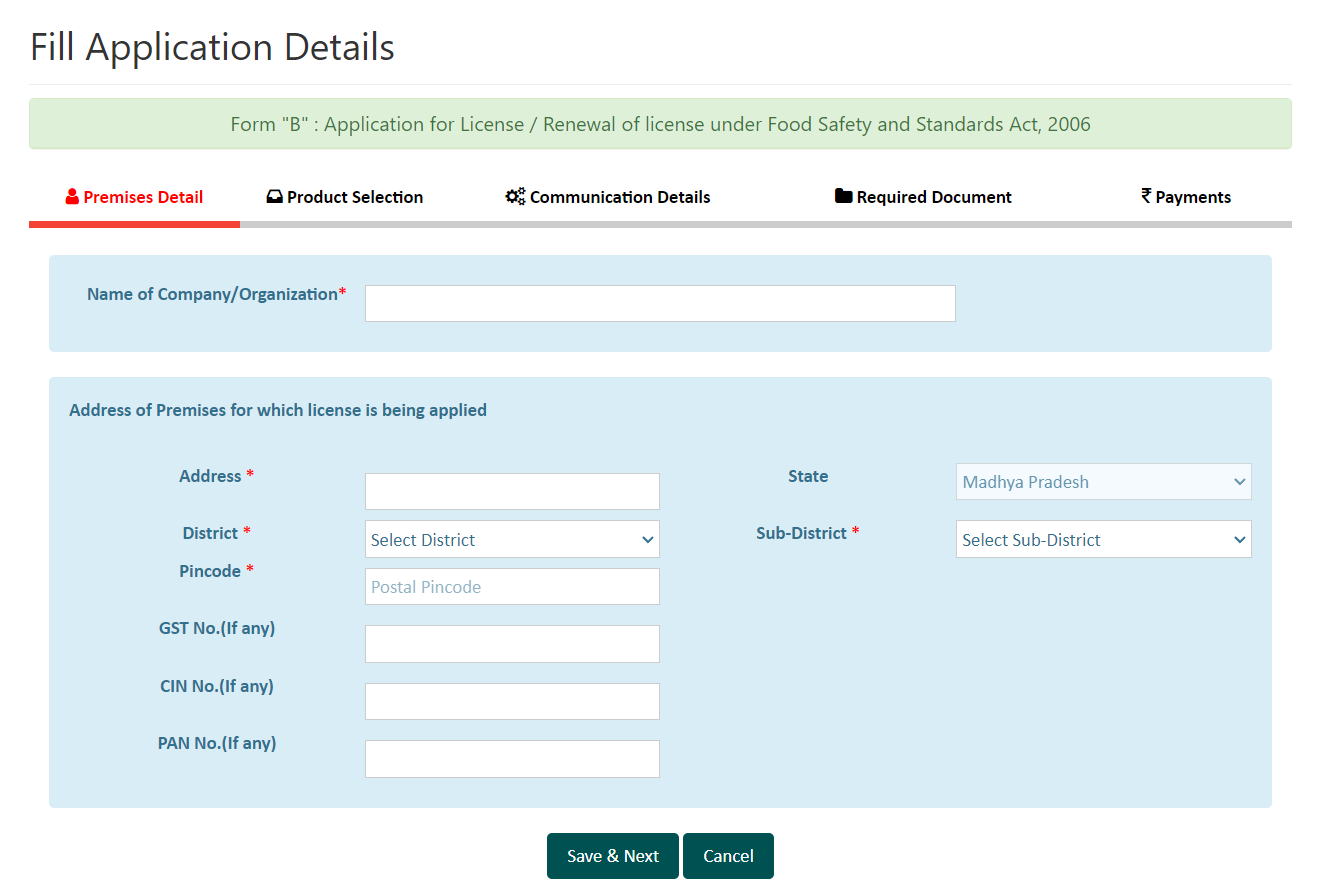
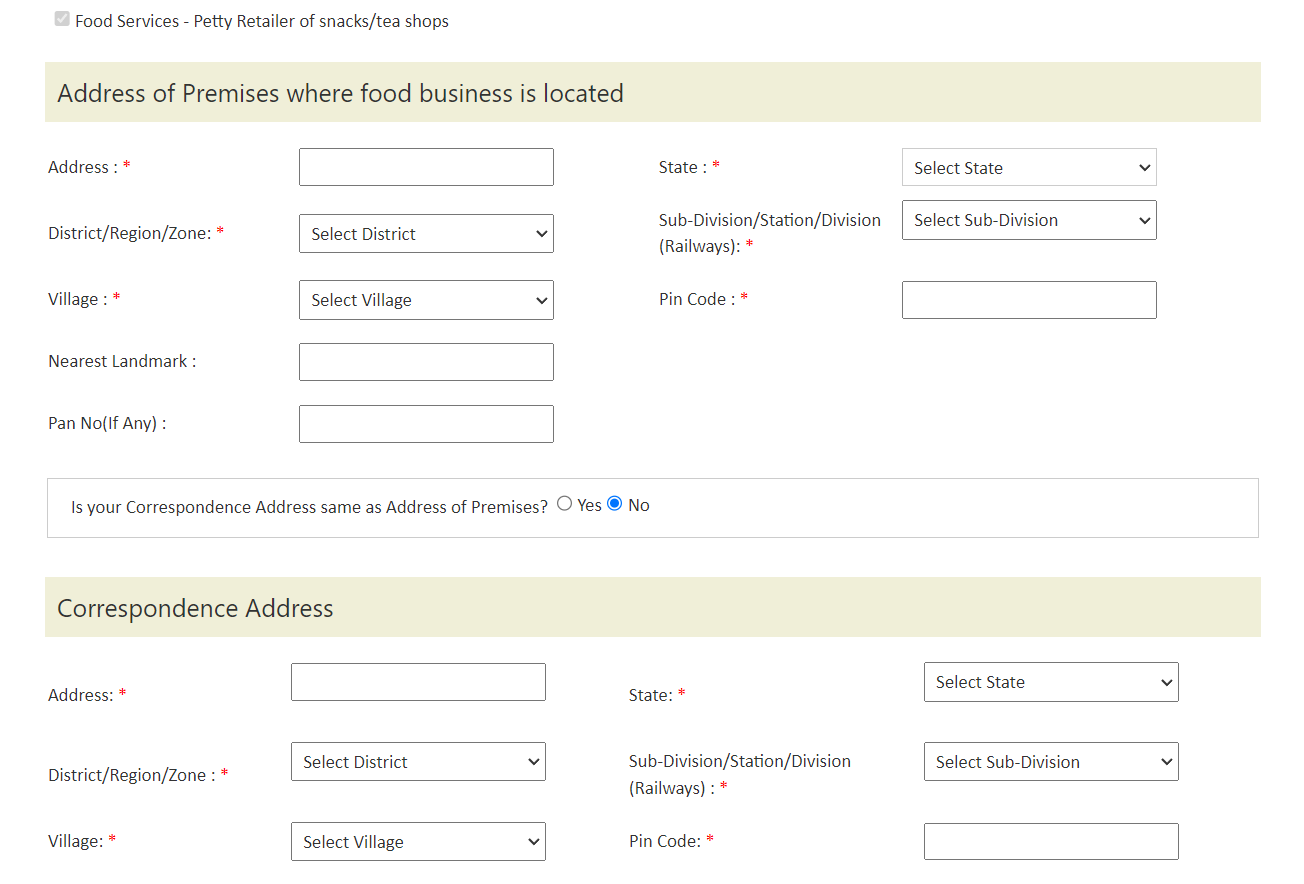
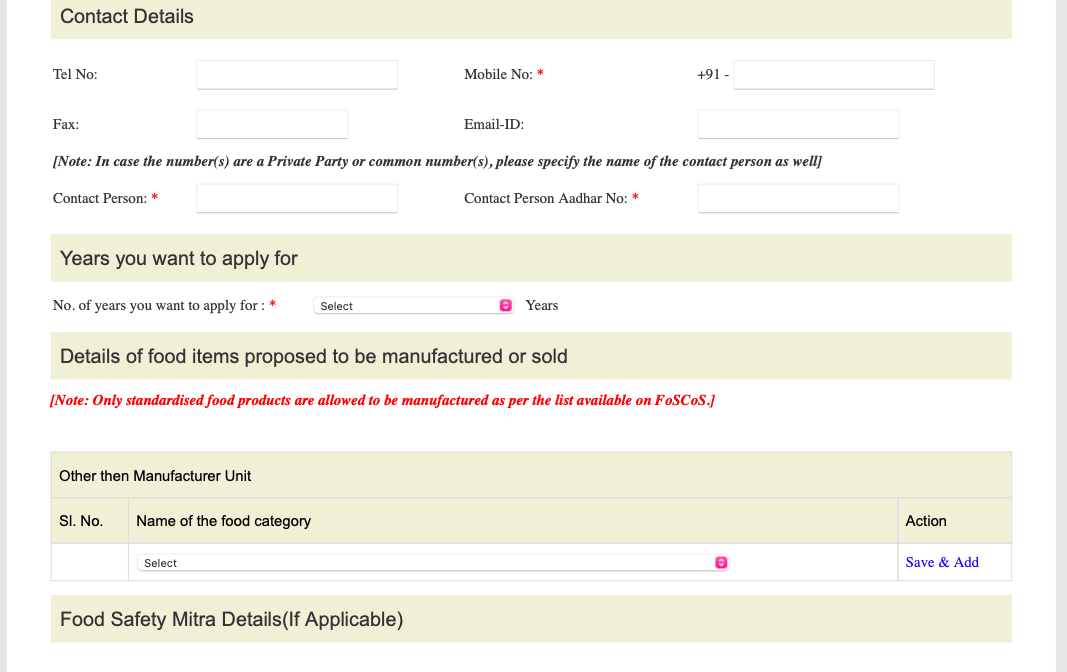
Step 6 : Fill the business premise related details and click on “Save & Next”
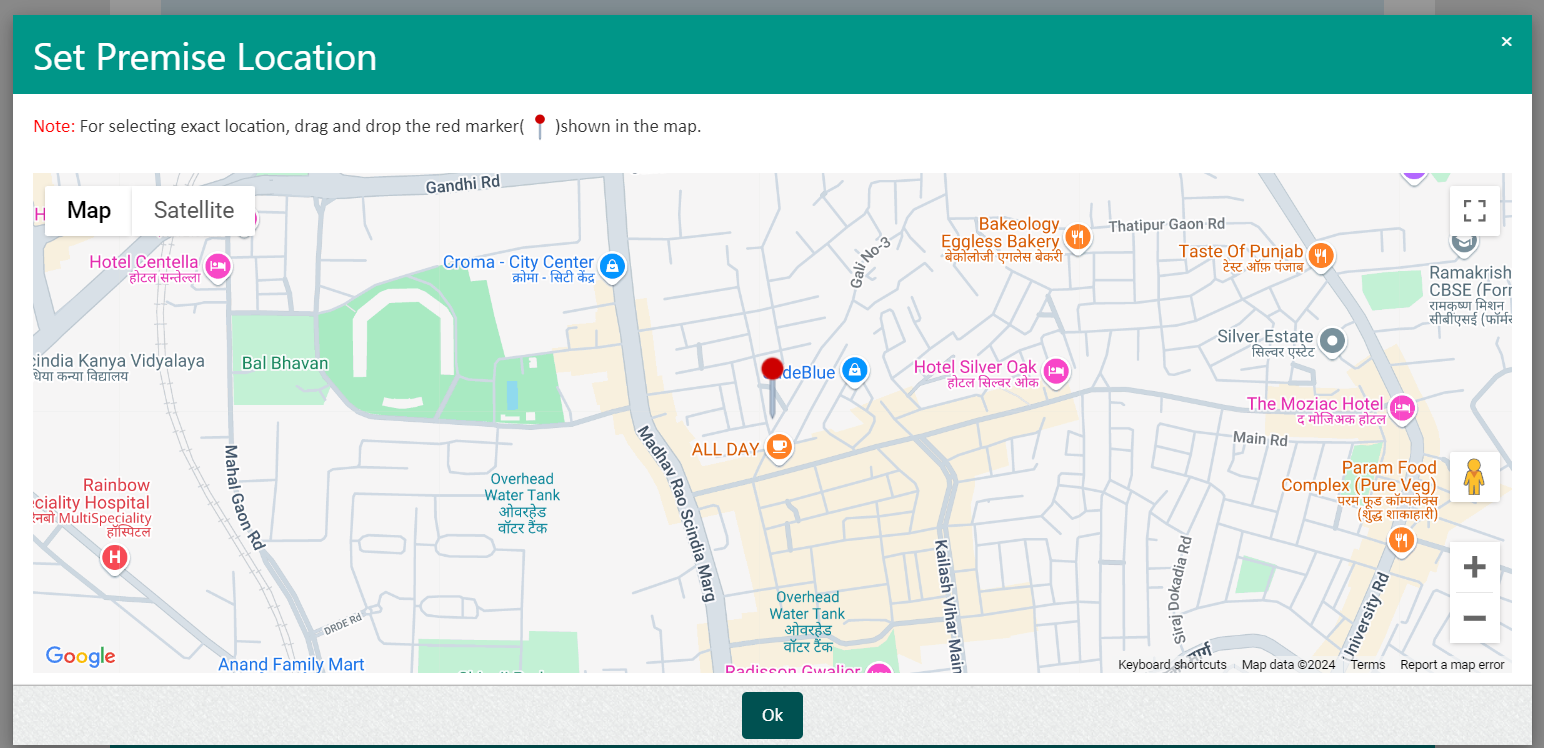
Step 7 : Drag the Red marker to the exact location of the premises and click “ok”.
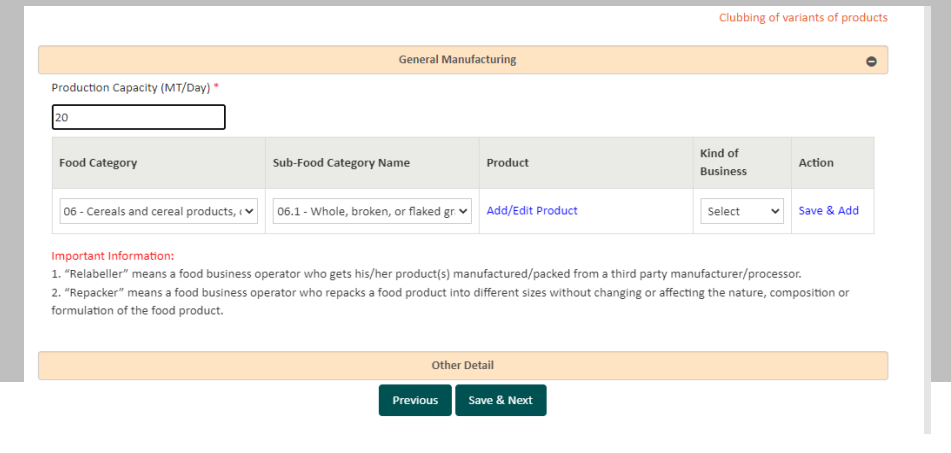
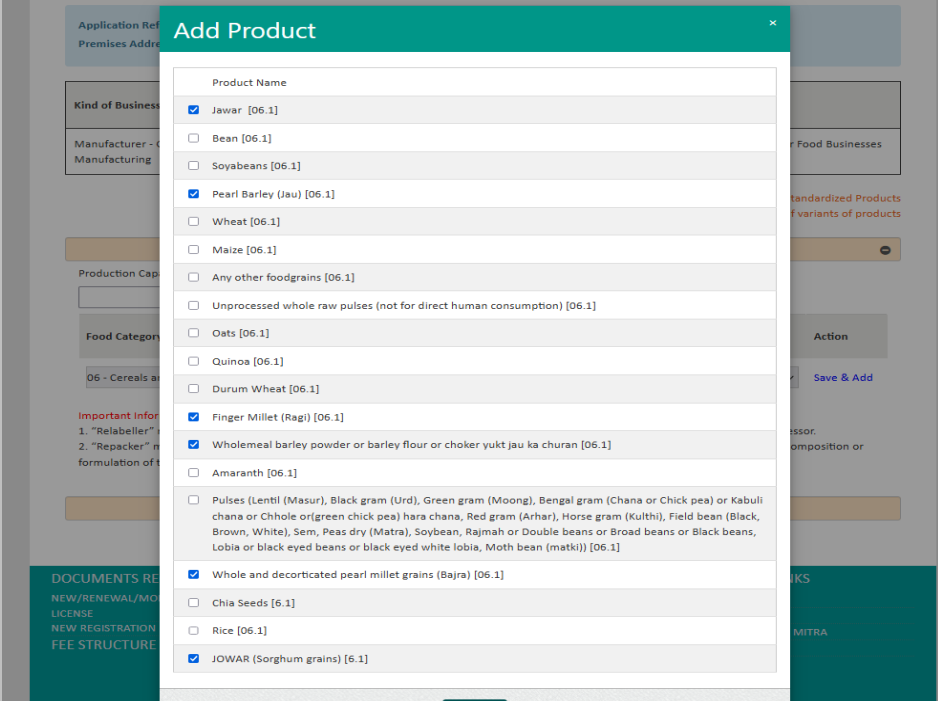
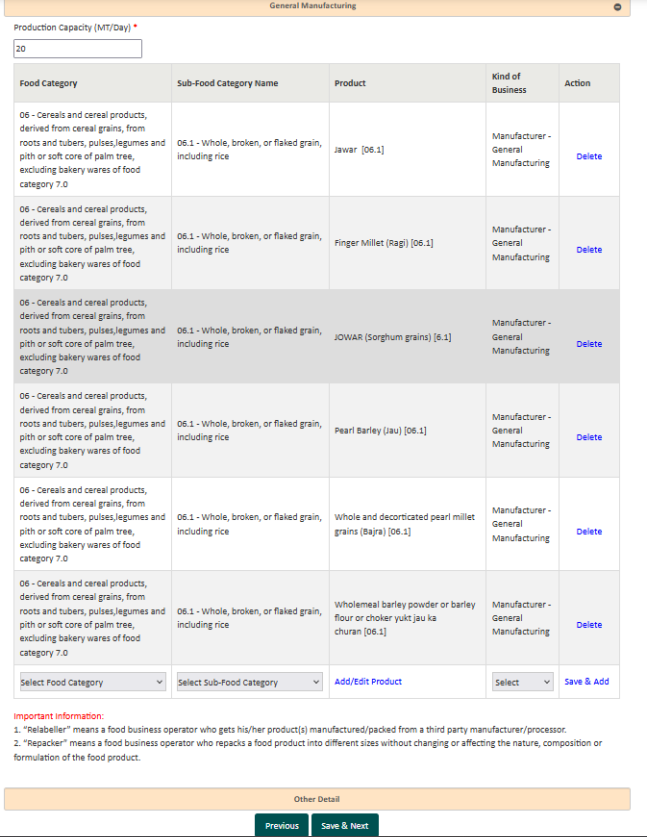
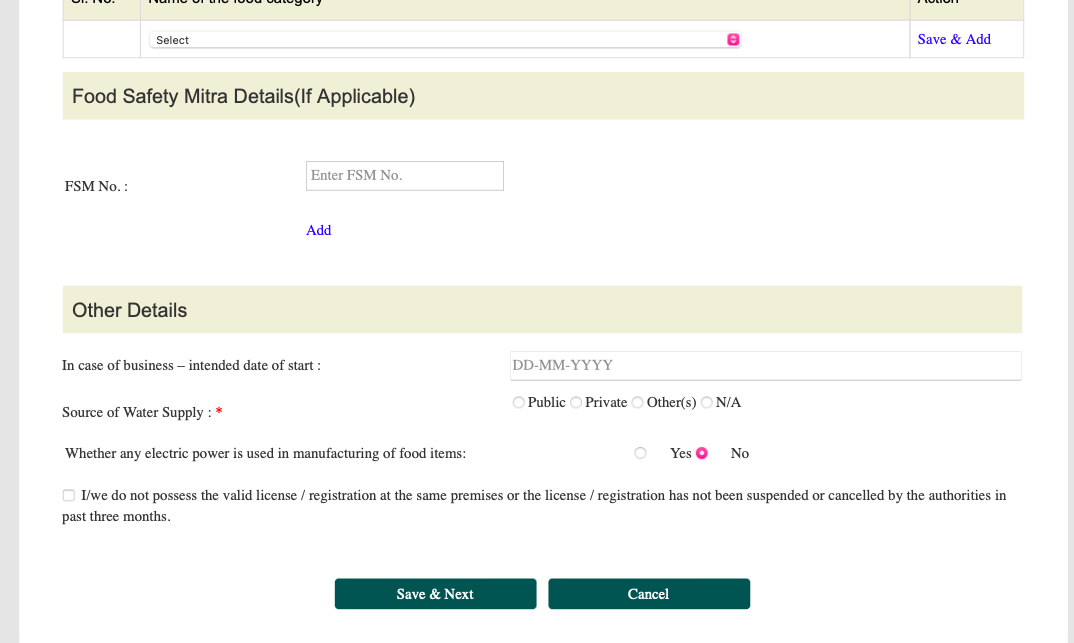
Step 8 : Click on General manufacturing and fill mandatory fields. Choose food category as 06- Cereals and Cereal Products -> Sub-food Category as 06.1 or 06.2 -> Select the Millet based product from the list.
For example – Finger millet (Ragi), Pearl Barley (Jau), Wholemeal barley powder or barley flour or chokar yukt jau ka churan, Whole and decorticated pearl millet grains (Bajra), Bajra Flour (Pearl Millet Flour), JOWAR (Sorghum grains), Jowar Flour (Sorghum Flour) etc. Then click on Save & Add.
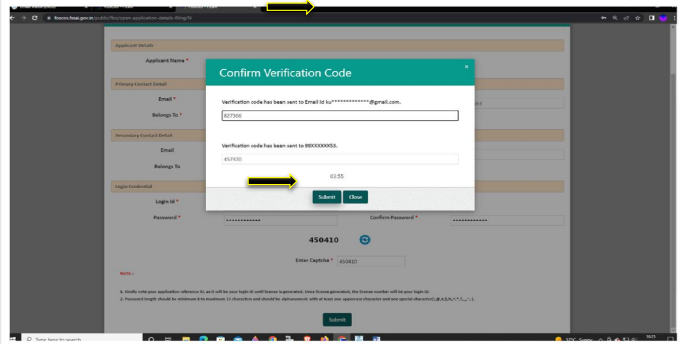
Step 9: If you want to continue with the application, you are required to create a login.
After creating the login details, Fill Form B and upload the documents required for the Manufacturing License [10].
Production Capacity Wise Fee:
State License [Milling Units having Production Capacity upto 1 MT/day] – Rs. 3000 per annum. State License [Milling Units having Production Capacity more than 1 MT/day] – Rs. 5000 per annum. Central License [Other than milling units] – Rs. 7500 per day In case of petty manufacturers having production capacity upto 100 Kg/day, only FSSAI Registration is required @Rs. 100 per year with only two documents.
Step 10: User can log in by clicking on the box “Apply for License/Registration Fee: Rs.100 to 7500 per year” as shown in the figure below:(yellow box)
Step 11: Select the State and Read the Note and Read the Group Heads of Kind of Business, Click on Kind of Business under which the food business falls, user can read the definition of all Kind of Business under it and click on the radio button under it to proceed further.
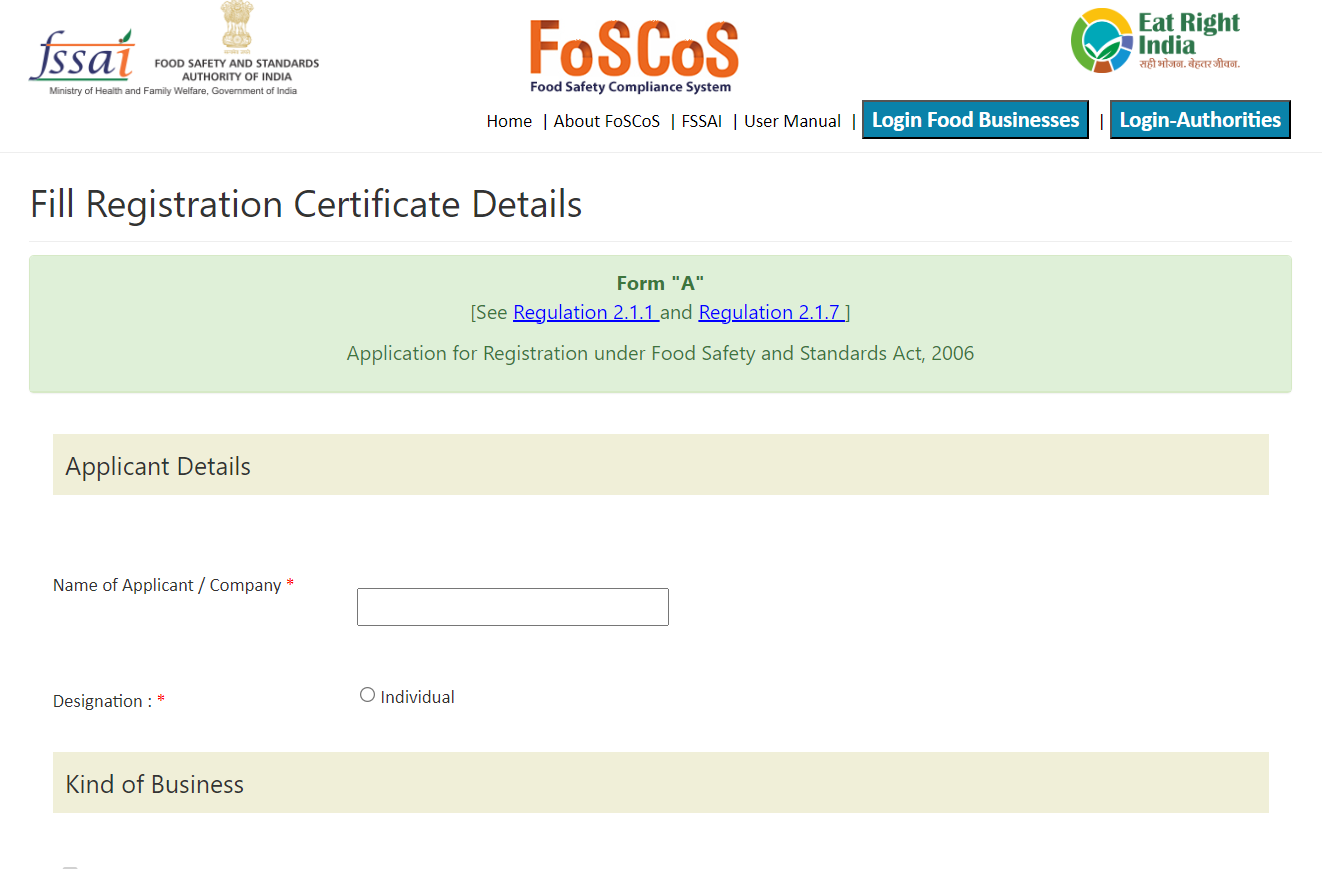
Step 12: Fill in all the mandatory fields as shown in Form A.
Step 13: Upload the documents, pay the fee with available modes and apply
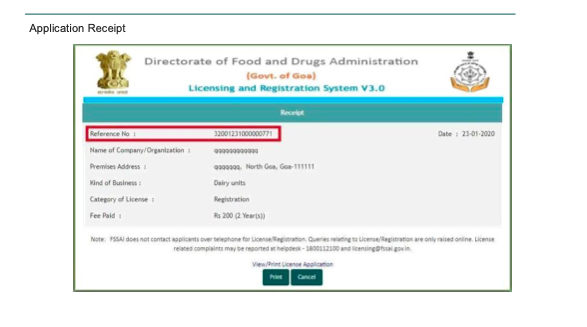
Step 14: After completing the payment, a receipt will be generated with a 17-digit reference number which can be used for future reference.
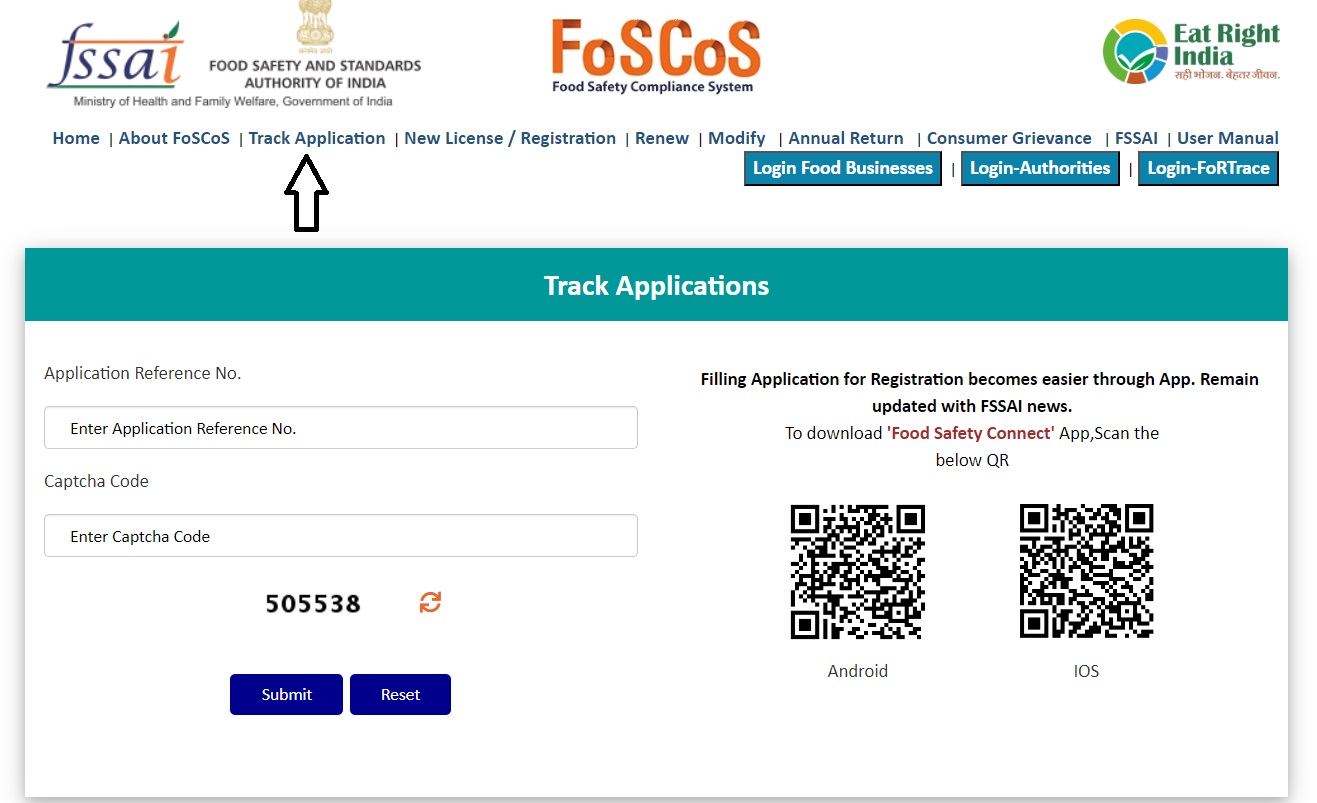
Step 15: User can track the status of application through the Homepage i.e. by using the reference number
Once your application is submitted, you can track your FSSAI registration status online.
Cost and Renewal Fee of FSSAI License
The cost of the FSSAI license depends on the type of license required. For instance, a Basic FSSAI registration has lower fees compared to a Central FSSAI license. The FSSAI certificate is issued once the application is approved, usually within 7-15 days.
The cost of an FSSAI license depends on the type of license you apply for. Basic FSSAI registration fees are minimal, while a Central FSSAI license for larger businesses can be more expensive. It’s important to note that the FSSAI license has a validity period of 1 to 5 years, after which you need to renew it. FSSAI license renewal can be done easily through the FSSAI website by submitting a renewal application before the license expires. Failure to renew your FSSAI license can lead to hefty fines or suspension of your food business license.
According to the FSSAI website the cost for registration is as follows :
Before applying, make sure you have all the documents required for FSSAI registration ready. The list of documents varies depending on the type of license. Basic FSSAI registration generally requires fewer documents than State licenses or Central licenses. You’ll need identity proof, address proof, a passport-sized photograph, and details of the business’s food products. For State licenses and Central licenses, additional documents such as a layout plan of your business premises, food safety management system plan, and water testing reports may be needed. We have provided a list of documents required for FSSAI Registration.
BASIC FSSAI REGISTRATION
Photo identity proof of the food business operators.
Business constitution certificate, i.e. partnership deed, certificate of incorporation, shop and establishment license or other business registration certificate.
Proof of possession of business premises, i.e. rental agreement, NOC from the owner of the rented premises, utility bills etc.
Food safety management system plan.
List of food products manufactured or processed.
Bank account information.
Supporting documents (if required) like NOC by Municipality or Panchayat, Health NOC, copy of License from the manufacturer, etc.
STATE FSSAI REGISTRATION
Form B duly completed and signed
Plan of the processing unit showing the dimensions and operation-wise area allocation
List of Directors/ Partners/ Proprietor with address, contact details, and photo ID
Name and list of equipment and machinery used with the number and installed capacity
Authority letter from manufacturer nominated a responsible person name and address
Analysis report of water to be used in the process to confirm the portability
Copy of certificate obtained under Coop Act 1861/Multi-State Coop Act 2002
CENTRE FSSAI REGISTRATION
Form B duly completed and signed
Plan of the processing unit showing the dimensions and operation-wise area allocation
List of Directors/ Partners/ Proprietor with address, contact details, and photo ID
Name and list of equipment and machinery used with the number and installed capacity
Authority letter from manufacturer nominated a responsible person name and address
Analysis report of water to be used in the process to confirm the portability
Source of raw material for milk, meat etc
Recall plan wherever applicable
Ministry of Commerce Certificate for 100% EOU
NOC/PA document issued by FSSAI
IE code document issued by DGFT
Form IX
Certificate from Ministry of Tourism
Supporting document for proof of turnover and transportation
Declaration form
Documents Required for FSSAI License Registration
Common Mistakes to Avoid During FSSAI Registration Practical advice on how to avoid delays and errors during registration
Incomplete or Incorrect Documentation: One of the most common mistakes is submitting incomplete or incorrect documentation. Ensure that you have all the required documents in the prescribed format and that the information provided is accurate and up to date.
Non-Compliance with Regulations: Failing to comply with the specific regulations and guidelines set by the FSSAI can lead to rejection or delays in the registration process. Familiarize yourself with the requirements and ensure that your food business meets all the necessary criteria.
Improper Categorization: FSSAI has different categories for food businesses based on their size, nature, and activities. It’s important to accurately categorize your business during the registration process. Choosing the wrong category can lead to complications in the future.
Incorrect Application Form: Filling out the application form incorrectly or providing incomplete information can lead to rejection. Double-check all the details, such as business name, address, contact information, and product details before submitting the application.
Inadequate Food Safety Practices: FSSAI places great importance on food safety and hygiene. Neglecting proper food handling, storage, and preparation practices can result in rejection of your registration. Ensure that your business follows the necessary food safety protocols and maintains high standards of hygiene.
Failure to Display FSSAI Logo: After obtaining FSSAI registration, it’s mandatory to display the FSSAI logo or the registration number on your food product labels. Neglecting to do so can result in non-compliance and legal issues.
Ignoring Renewal Deadlines: FSSAI registration is not a one-time process. It requires periodic renewal. Missing the renewal deadlines can lead to the cancellation of your registration. Keep track of the renewal dates and submit the necessary documents within the specified timeframe.
Neglecting Training Requirements: FSSAI often requires food handlers to undergo training programs on food safety and hygiene. Failing to provide the necessary training certificates or ignoring the training requirements can lead to complications during the registration process.
Conclusion
FSSAI registration is crucial for any food business in India to ensure compliance with food safety standards. It not only enhances credibility but also builds trust among consumers. The registration process, while straightforward, can be prone to delays due to incomplete documentation, incorrect registration types, or lack of knowledge about the required procedures. By carefully checking all documents, choosing the correct registration category, and staying informed about FSSAI updates, you can avoid common pitfalls and ensure a smooth process. If needed, seeking expert assistance can further help in minimizing errors. Ultimately, securing your FSSAI registration is an essential step towards running a legally compliant and trustworthy food business.
Contact TMWala today and obtain your FSSAI License and Registration!
Copyright Registration in India, Overview of the Indian Copyright Act: Understanding Your Rights
You’ve poured hours, effort, and passion into creating something unique, and now it’s time to ensure it’s protected. The Indian Copyright Act is the law that does just that; it shields your creative work from being used without your permission. Whether you’re an author, artist, musician, or software developer, this act plays a crucial role in safeguarding your intellectual property in India. But what exactly does it cover, and how does it work? Let’s break it down in a simple, easy-to-understand way so that copyright law feels less daunting and more empowering for you.
The Indian Copyright Act
The Indian Copyright Act, enacted in 1957, is the primary law governing copyright protection in India. It provides creators with exclusive rights over their original works, allowing them to control how their work is used, distributed, and monetized. Essentially, this law ensures that if you create something, no one else can use it without your permission, at least not legally. But don’t worry, this isn’t just for big corporations or blockbuster movies. It applies to everyday creators like you, whether you’re writing a blog, composing music, or designing an art piece. In short, if you’ve created something original, the law is on your side.
The act has undergone several amendments to keep up with the changing world, especially with the rise of digital content. With the internet making it easier than ever to share and, unfortunately, steal creative work, the Indian Copyright Act has adapted to address modern challenges. It gives you both moral and economic rights, so you’re protected not just financially, but also in terms of how your work is presented or modified.
Scope of copyright
You might be wondering, “What exactly can I protect under this law?” The Indian Copyright Act covers a wide variety of original works, including literary, artistic, musical, and cinematographic creations. This means your book, poem, painting, song, or even a short film can all be registered under the law. Even if you’re into something more technical like computer software or architectural designs, copyright law has your back.
While copyright covers a wide range of original works, there are some things it doesn’t protect. You might be surprised to learn that ideas, procedures, methods, and concepts fall into this category. For instance, if you’ve thought up a brilliant business idea or a revolutionary new process, copyright won’t protect the idea itself. However, the way you express that idea, whether in writing, as a presentation, or in another tangible form, can be protected.
Facts and data themselves also aren’t protected by copyright, although how they’re presented might be. If you’ve written a report or compiled data into a unique format, the presentation could be copyrighted, but not the raw information. The distinction is important for researchers and journalists who deal with data and information regularly.
Copyright protection also kicks in the moment your work is created, even without registration. However, getting your work officially registered with the Copyright Office gives you stronger legal standing in case someone tries to copy or misuse it. If you ever find yourself in a dispute, having that registration certificate can be a lifesaver.
Exclusive Rights for Creators
Now, what do these exclusive rights actually mean? Under the Indian Copyright Act, creators like you are granted several key rights. First off, there’s the right to reproduce the work, meaning no one else can make copies of your creation without your permission. Whether it’s printing more copies of your book or making digital copies of your music album, the decision is entirely up to you.
You also have the right to distribute your work. So, if you want to sell, rent, or share your work with the public, you can do so on your terms. You have full control over how and where your work is shared. Want to give away free copies of your eBook? That’s your choice! Want to sell limited editions of your art piece for a premium price? Totally up to you.
One of the coolest things about the Indian Copyright Act is that it also gives you the right to perform or display your work publicly. If you’re a musician, this means only you get to decide where and when your song gets played live. If you’re an artist, you control how your painting is exhibited. This aspect of copyright is particularly important in the entertainment and arts industries, where public performance or display is a significant part of a creator’s income.
Moral and Economic Rights
Beyond the basic rights to reproduce, distribute, and perform your work, the Indian Copyright Act also grants you two important types of rights: moral rights and economic rights.
Moral rights allow you to claim authorship of your work and protect your reputation. So, if someone else tries to take credit for your creation or distorts it in a way that could harm your reputation, you have the right to step in. Even if you’ve transferred your copyright to someone else, you still retain your moral rights. That means your name remains attached to your work, and no one can alter it in a way that might misrepresent you as a creator.
Economic rights, on the other hand, refer to your ability to financially benefit from your creation. Whether it’s selling copies of your work, licensing it for use, or collecting royalties, you get to decide how your creation is monetized. If someone else wants to use your work commercially, they need to pay you for that privilege. This is where your copyright truly turns into a valuable asset.
Staying Protected: Why It Matters
In today’s digital age, when content is shared globally within seconds, having a strong understanding of your copyright protection is more important than ever. The Indian Copyright Act ensures that your creative work stays yours. Whether you’re an artist, author, musician, or any other type of creator, this law provides you with a legal framework that keeps you in control.
So, take a deep breath, and remember that the Indian Copyright Act is there to safeguard your hard work and creativity. Whether you’re just starting your creative journey or already have a portfolio of work under your belt, understanding this law is your first step towards protecting what you’ve created.
Types of Copyright in India: What You Need to Know
Understanding the types of copyright in India is essential for every creator. Whether you’re writing a novel, composing a song, designing a logo, or building software, copyright ensures that your work is protected. But not all creative works fall under the same type of copyright protection. Depending on what you’ve created, the specific rights you hold may vary. Let’s take a fun and easy dive into the different types of copyright in India and how each one can protect your unique creations.
Literary Works: More Than Just a Book
When you think of literary works, your mind probably jumps to novels and books. But in India, copyright for literary works covers much more than that! From short stories, poems, and essays to blog posts, articles, and even computer programs, yes, you heard that right, literary works come in many forms.
If you’re a writer, blogger, or even a coder, your original text or code is protected under this category. Once you’ve put your thoughts, ideas, or lines of code down in a tangible form, you automatically hold copyright. This means you have exclusive rights to reproduce, distribute, and even translate your work. So, no one can publish your blog post or replicate your software without your permission. Pretty empowering, right?
And here’s something fun: even recipes can sometimes be considered literary works, but only if they go beyond a simple list of ingredients and include a creative process or storytelling. So, if you’ve been writing that cookbook with colorful anecdotes and a unique voice, congratulations! Your creative flair is officially protected.
Artistic Works: For the Creatives Out There
There are two types of Artistic Works for which Copyright can be granted in India! 1. For Artistic Works to be used in or in relation to Goods or Services 2. For Artistic Works not to be used in or in relation to Goods or Services
1. For Artistic Works to be used in or in relation to Goods or Services
There is an overlap between the Trademarks and Copyright. Lets explain this with a help of a simple example.
Imagine you created a Logo for use on a Food Product, now will that logo be protected under Copyright or Trade Mark? The answer is both! Since, the Logo is essentially an artistic work which you use in relation to goods or services, the logo itself is a Copyrightable material, but once it is used in relation to goods or services, it becomes a trade mark as it identifies the goods or services of one person from the other.
In India, there is a unique way of overcoming this overlap while ensuring that there is no disparity or irregularity between Trade Marks & Copyrights. This type of copyright is called “Copyrights in Artistic Work capable of being used in or in relation to Goods or Services”.
Since, this is a matter which concerns both Trade Marks & Copyright it is the harmony between the two Laws and the two Government Offices which makes this protection possible.
For a person who wants his logo, artistic work, packaging, device, whatsoever to be registered under the Copyright Act which he intends to use in or in relation to goods or services, the said person has to first obtain a No Objection Certificate called a Search Certificate from the Trade Marks Registry. This application is filed on Form TM-C under Rule 22 of the Trade Marks Rules, 2017. There are two methods of obtaining this Search Certificate:
a. The Normal Method: Normal Method entails a Government Fee of Rs.9,000/- wherein the Search Certificate is usually issued after 6-9 months.
b. The Urgent Method: Under Urgent Method, the Government Fee increases to Rs.30,000/- and the Search Certificate is usually issued within 1-2 months.
After this Search Certificate is issued by the Trade Marks Registry, you have to approach the Copyright Registry and file Form XIV wherein the details of the Certificate and the Certificate Number will be mentioned. Further, the copy of the certificate will also be sent to the Copyright Registry. Further, since it is different from normal artistic works, the Fee to be paid before the Copyright Registry is Rs.2,000/-.
You can easily file Copyrights with TMWala for works which can be used in or in relation to Goods or Services.
2. For Artistic Works not to be used in or in relation to Goods or Services
For all you painters, sculptors, photographers, and designers out there, artistic works are the copyright category you should care about. This category covers things like paintings, drawings, sketches, sculptures, photography, and even architectural designs.
What makes artistic works special is the way they protect the visual expression of an idea. For example, if you paint an original masterpiece or snap a beautiful photo, copyright ensures that no one can reproduce or display your artwork without your permission. It’s like putting a protective bubble around your creation so others can’t steal it or use it without crediting you.
Even graphic designers and digital artists are included here. So, if you’ve spent hours crafting a unique logo or designing a website layout, your work is protected under artistic copyright. And get this—you can even license or sell your work, which means you could potentially make money by allowing others to use it in certain ways. Who knew copyright could turn into a business opportunity?
Musical Works: Protecting the Sound of Your Creativity
Music lovers, this one’s for you! Musical works in India cover everything from the melody, harmony, and composition of a piece to the lyrics. Whether you’re a songwriter, composer, or musician, your music is automatically copyrighted the moment it’s recorded in some form, like a music sheet or a digital file.
One of the coolest things about musical copyright is that it protects not only the written or recorded piece, but also any public performance. So, if you’re performing your song at a concert or uploading it to streaming platforms, no one can legally use, copy, or distribute it without your consent. You can also license your music to films, advertisements, or other artists, potentially earning royalties every time your song is played.
And here’s a fun fact: even if you’re just humming a tune and someone records it without your permission, that counts as infringement! So, whether you’re a full-fledged musician or just dabbling in song writing, your creative sounds are well-protected under Indian copyright law.
Cinematographic Films: For the Filmmakers
If you’re a filmmaker, director, or producer, copyright protection for cinematographic films is a must-know. This type of copyright covers everything involved in making a film, including the script, dialogues, music, and visual elements. Whether it’s a feature-length movie or a short film, once it’s recorded, it falls under this category.
Cinematographic films also cover animations, documentaries, and even music videos. So, if you’re into visual storytelling, this type of copyright ensures that you maintain control over your work. No one can reproduce, sell, or broadcast your film without your approval. You’re the boss of your content, and you get to decide where and how your film is shown.
And guess what? Even trailers and teasers can be protected under this type of copyright, so your sneak peeks are just as important as the final product. This means every aspect of your film is safeguarded, allowing you to share your vision with the world while keeping your rights intact.
Sound Recordings: Keeping Your Audio Safe
Let’s not forget about sound recordings! This type of copyright protects any recorded sound, whether it’s music, speeches, or even a podcast. If you’ve ever recorded an original audio file—whether it’s a song or a spoken-word performance—you’re the owner of the copyright for that sound recording.
What’s cool about sound recording copyright is that it covers not just the content itself, but also the specific recording of that content. So, if you record a song or produce a podcast, both the recording and the content within it are protected. If anyone wants to use or distribute your audio file, they’ll need to seek your permission first.
For all you podcasters out there, this means your episodes are covered too! Whether you’re interviewing a guest or recording a solo episode, your voice, music, and the entire recording are safe from misuse. So go ahead and hit record with confidence!
Dramatic Works: The Stage is Yours
If you love the theater or scriptwriting, dramatic works might be your favorite type of copyright. This category includes plays, scripts, and even choreography. If you’ve written a play or scripted a stage performance, copyright ensures that only you or those you permit can perform, adapt, or publish your work.
It’s not just about protecting your text, though. Dramatic copyright also covers any visual or audio elements that are part of the performance. So, whether you’re staging a play or choreographing a dance, every part of your creation is legally protected. No one can take your script or performance and stage it without giving you the credit you deserve.
Examples of Copyright in Action: Everyday Situations that Show Its Power
Let’s explore some real-world examples of copyright in action and how it can make a difference for creators just like you.
1. The Music Industry: Copyright in Action to Protect Musicians
A famous example is the “Blurred Lines” case. In 2015, the creators of the hit song “Blurred Lines,” Robin Thicke and Pharrell Williams, were sued for copyright infringement. The estate of Marvin Gaye claimed that the song copied elements from Gaye’s 1977 classic “Got to Give It Up.” After a long trial, the court ruled in favor of Gaye’s estate, awarding them millions in damages. This case shows just how powerful copyright is in protecting musicians and ensuring that original works are respected. So, the next time you create a masterpiece, remember that copyright can act as your safety net.
2. Movies and TV Shows: How Copyright Safeguards Screen Content
You know that feeling when you sit down to watch your favorite movie or TV show? Copyright is working hard behind the scenes to protect the creators and producers of that content.
One fascinating example is the lawsuit involving the movie “Avatar.” James Cameron, the famous director of “Avatar,” faced numerous copyright lawsuits after the movie was released. Several writers claimed that the plot and characters of “Avatar” were based on their earlier works. However, after careful review, courts ruled that Cameron’s ideas were original, showcasing how copyright laws can protect a creator’s vision while ensuring that disputes are resolved fairly.
A show like Game of Thrones, for example, is not only protected as a full series, but each episode, script, and even the theme music is copyrighted. So, every time you enjoy an episode, you’re watching copyright in action, working to protect the showrunners and everyone involved in the creative process.
3. Publishing: Protecting Writers Through Copyright
If you’ve ever written a book or even a blog post, you’ve likely wondered how to protect your work from being copied.
Take the case of Harry Potter creator J.K. Rowling. Rowling’s iconic book series is protected by copyright, meaning that any unauthorized use of her work, whether it’s fanfiction that too closely mirrors the original, or someone trying to publish her books without permission, can result in legal action. In fact, Rowling has been involved in multiple copyright cases where unauthorized adaptations or knock-off books were taken to court. Thanks to copyright, her world-famous stories remain under her control, ensuring that her original work is respected and legally protected.
4. Digital Content: Protecting Creators in the Online World
Many YouTubers rely on copyright to prevent others from re-uploading or using their videos without permission.
A famous case is that of YouTuber Ethan Klein, from the channel H3H3Productions, who was sued for copyright infringement after using clips from another YouTuber’s video in a satirical review. However, the court ruled in favor of Klein, citing fair use, a doctrine that allows limited use of copyrighted material for purposes like criticism or commentary. This case shows that while copyright protects creators, there are still boundaries when it comes to how works can be used, especially in the digital age.
Even on platforms like Instagram or TikTok, copyright can help you maintain control over your creations. Whether it’s a viral dance, a graphic design, or a witty caption, your content is protected, ensuring others can’t profit from your creativity without your approval.
Final Thoughts on Types of Copyright in India
India’s copyright law offers creators like you comprehensive protection for a wide range of creative works. Whether you’re writing, designing, composing, or filming, knowing the types of copyright in India helps you better understand how your creations are protected. It’s not just about shielding your work from theft it’s about empowering you to control and monetize your creative efforts. So, go ahead and create with confidence, knowing that copyright law is there to back you up!
How to Apply for Copyright in India: Simple Steps to Protect Your Work
So, you’ve created something amazing, and now you want to make sure no one can steal it. That’s where copyright registration comes in! But don’t worry, the process isn’t as complicated as it sounds. In this guide, we’ll walk you through the step-by-step process of how to apply for copyright in India. We’ll also cover the documents required, the timelines you should expect, and how you can track your application. By the end of this, you’ll have a solid understanding of how to secure your intellectual property.
Step-by-Step Process to Apply for Copyright
Applying for copyright in India is a fairly straightforward process that you can even do online. Here’s a breakdown to make it simple for you:
Visit the Official Copyright Website The first step is heading over to the Copyright Registry’s Official website https://copyright.gov.in/. They have an online e-Filing system, where you can submit your copyright application. It’s as easy as ordering your favorite item online. You just need to follow the prompts and fill in the required details.
Create an Account If you don’t already have an account on the copyright portal, you’ll need to create one. Don’t worry it only takes a few minutes to set up by entering your email and some basic info.
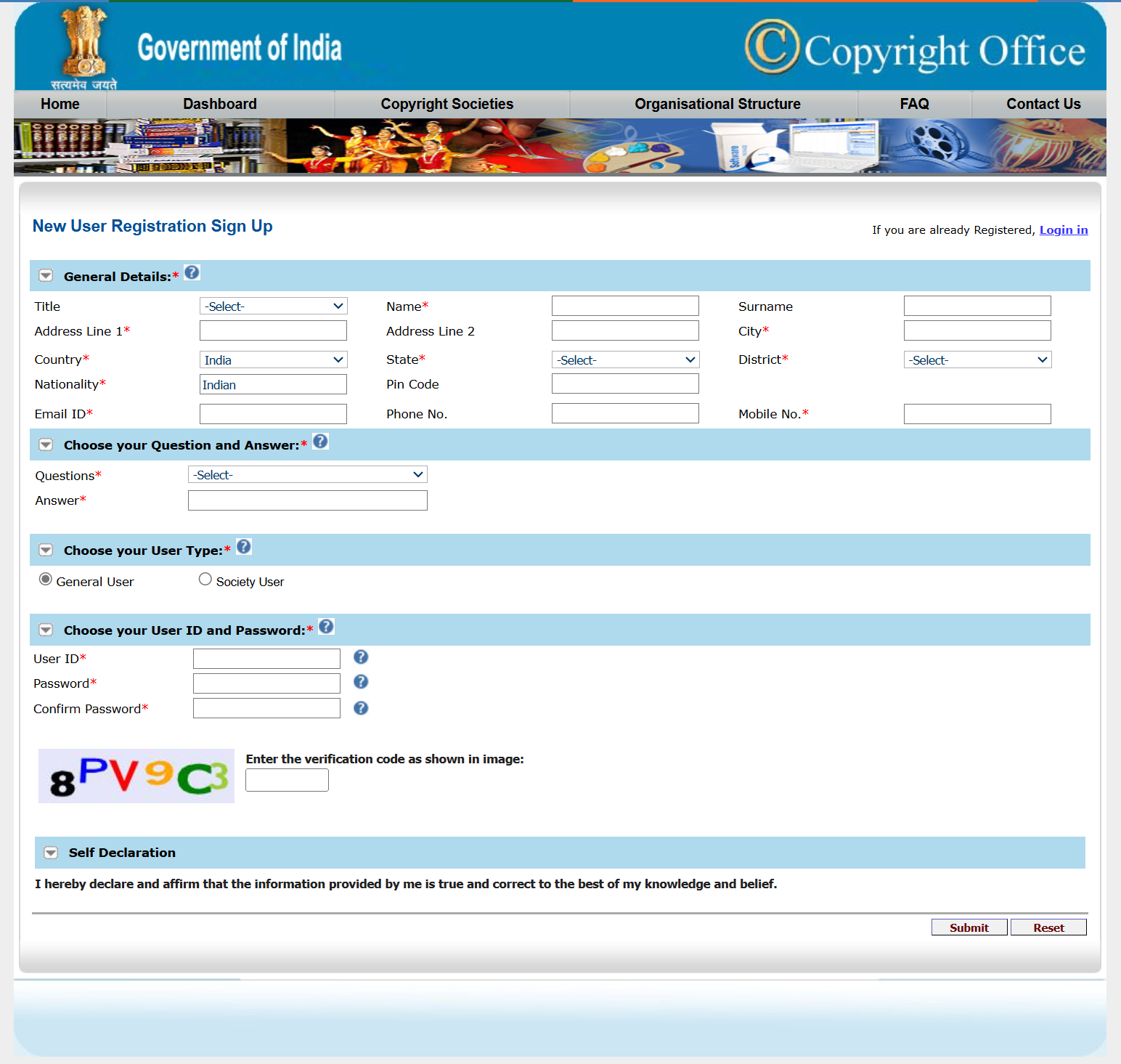
Go to https://copyright.gov.in/ >> Registration of copyright (Form-XIV) >> Click here for New User Registration New User Registration
Alternatively, you can click the link below and directly create an account with the Copyright Registry Online
Fill in the form and click on Submit Button. Once your account is created, you’ll receive a confirmation link in your email. Click that, and you’re all set to move on to the next step!
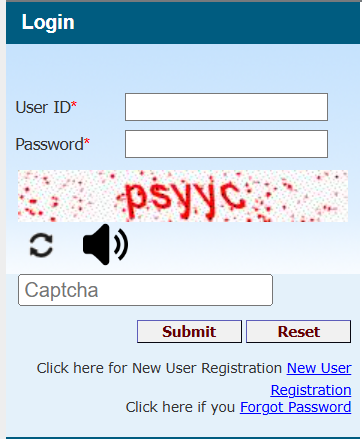
Login & Create a new application Go to https://copyright.gov.in/ and click on Registration of copyright (Form-XIV). You will be redirected to a login page as below:
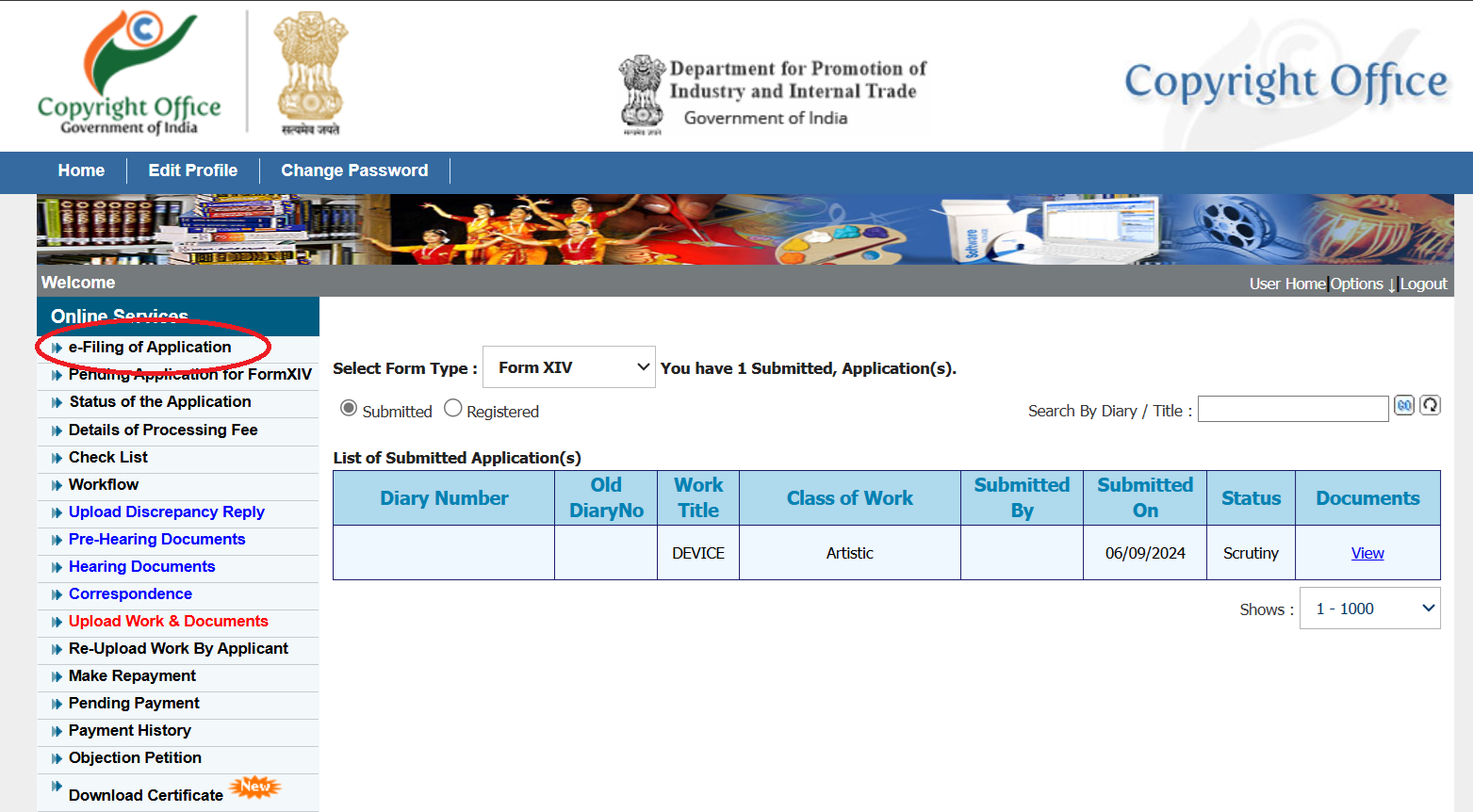
Use your Login ID & Password which you created under Step-2 to Login to the Copyright E-Filing Portal. After logging, click on E-Filing of Application on the Left Hand Side of your navigation bar
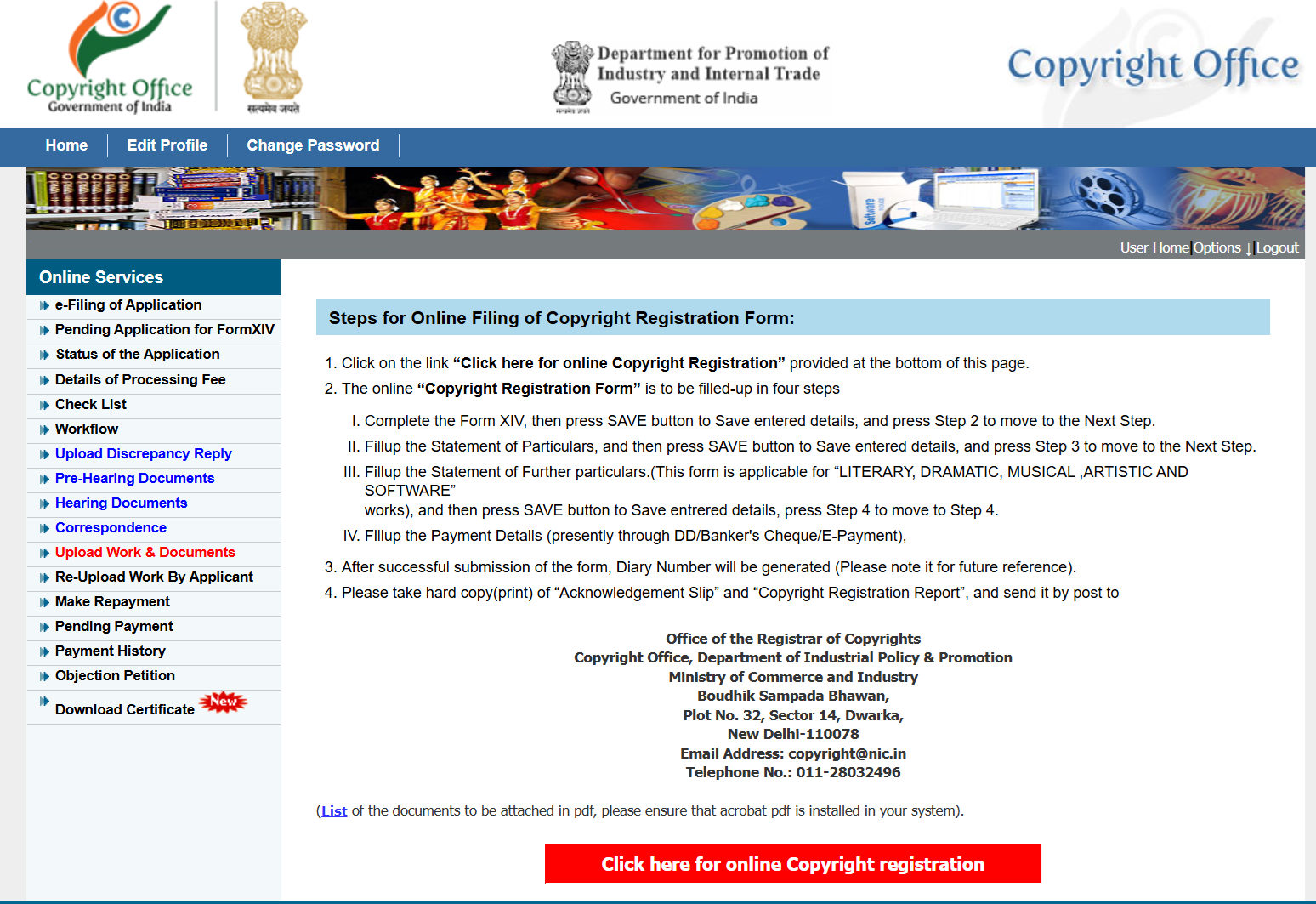
Then you will be redirected to a new page. Click on the red button which says “Click here for online Copyright registration”
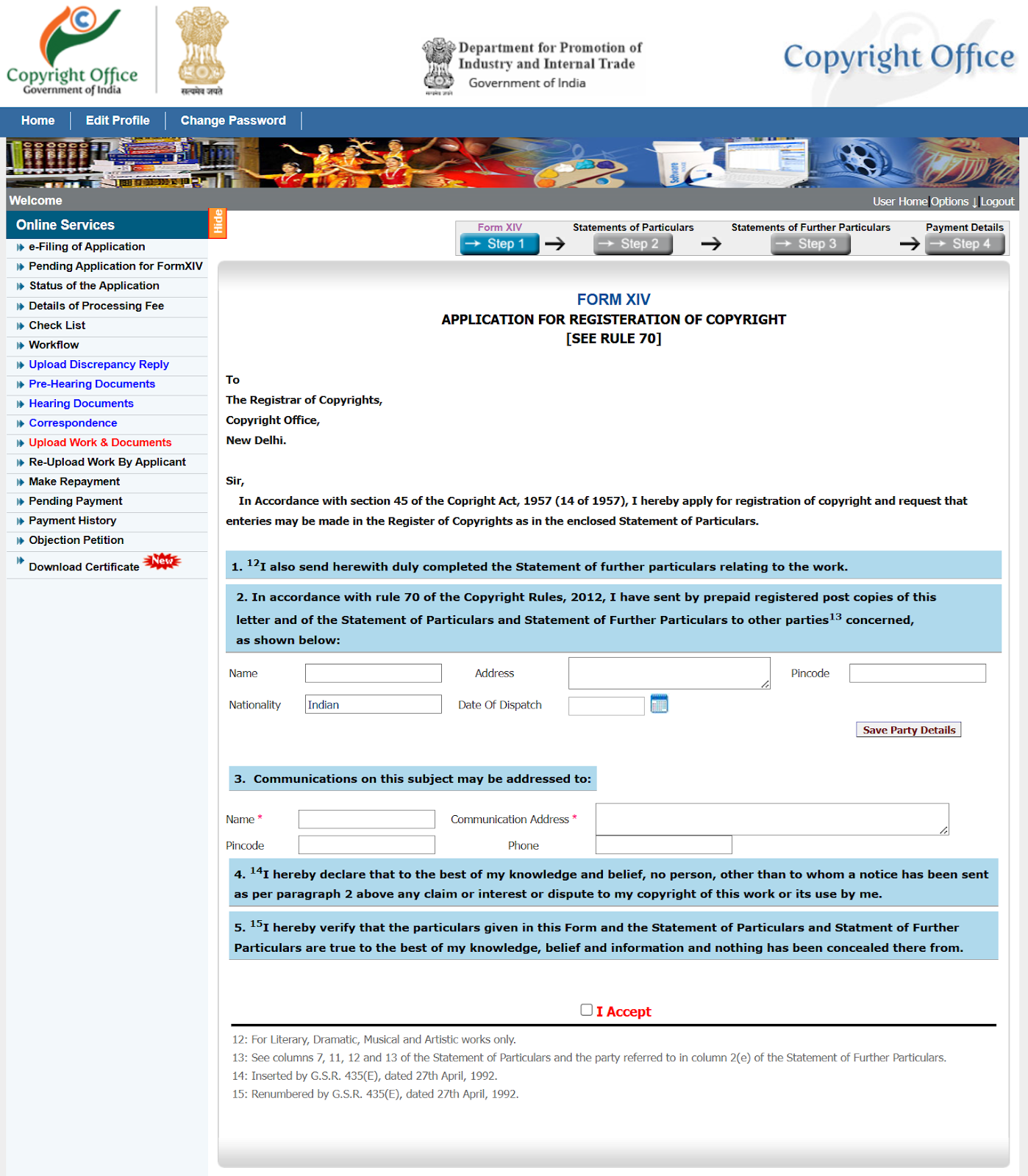
Fill Out the Copyright Application Form This is where the details of your work come in. The application will be filed in Three (3) Sections i.e. Form XIV (Application for Registration of Copyright), Statement of Particulars & Statement of Further Particulars. Remember to be truthful about your statements and filings always!
Form XIV (Application for Registration of Copyright) Under Sr. No.2 of the above form, mention the Name, Address & Particulars of the person who is applying for Copyright Registration. Then click on “Save Party Details”. If there are more than one applicants, after clicking on Save Party, you can add multiple applicants.
Under Sr No.3, mention the Address & Particulars of the person who will be responsible for complying with all the communications from the Copyright Registry. Generally this will be the applicant himself. It is important to mention correct particulars here because the Copyright Registry will make contact through these particulars.
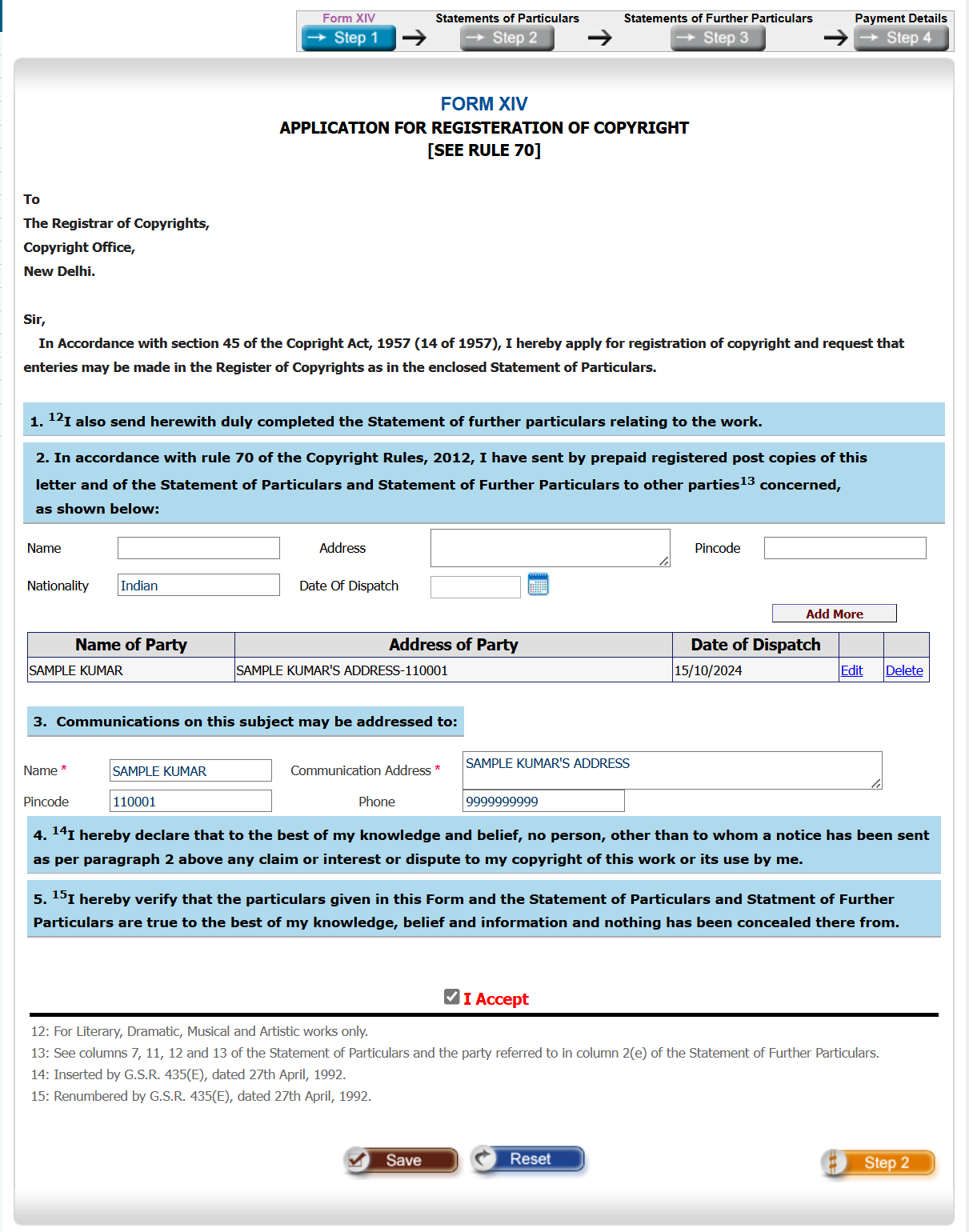
Finally click on “I Accept” and then click on Save. Your application will look something like this
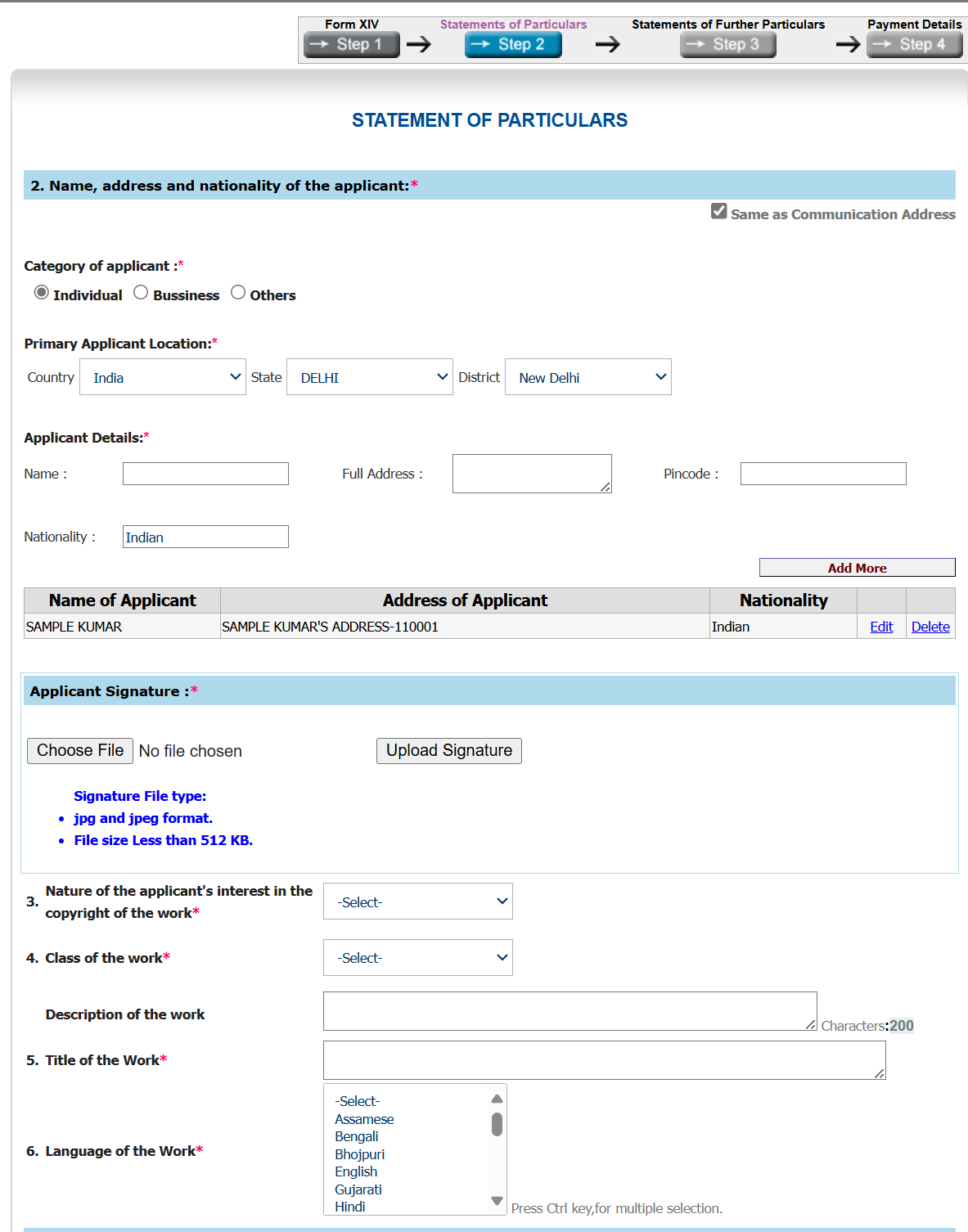
You will be redirected to Step-2 called Statement of Particulars We will go step-by-step here Choose the category of the applicant. Generally if you are individual, choose the Individual Category. Select your location from the dropdown and add the applicant details and click on “Save New Applicant”. Your details will be saved and you can add more than one Applicants. You then have to upload your E-Signatures by clicking a photo of your signatures on a White Paper and uploading them.
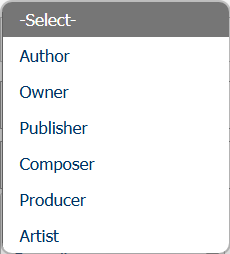
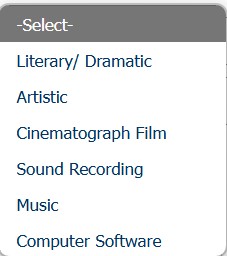
Nature of Applicant refers to the interest and position of the applicant in relation to the copyright work. If the applicant is the Author, mention Author, if the applicant is the Owner, choose Owner from the dropdown. Class of work refers to the type of work you are looking to register. You can choose from the dropdown Then mention the Description & Title of the work and choose the language in which the work is prepared. In case the work contains multiple language, you can select multiple languages by holding Control (ctrl) on your keyboard and selecting multiple languages.
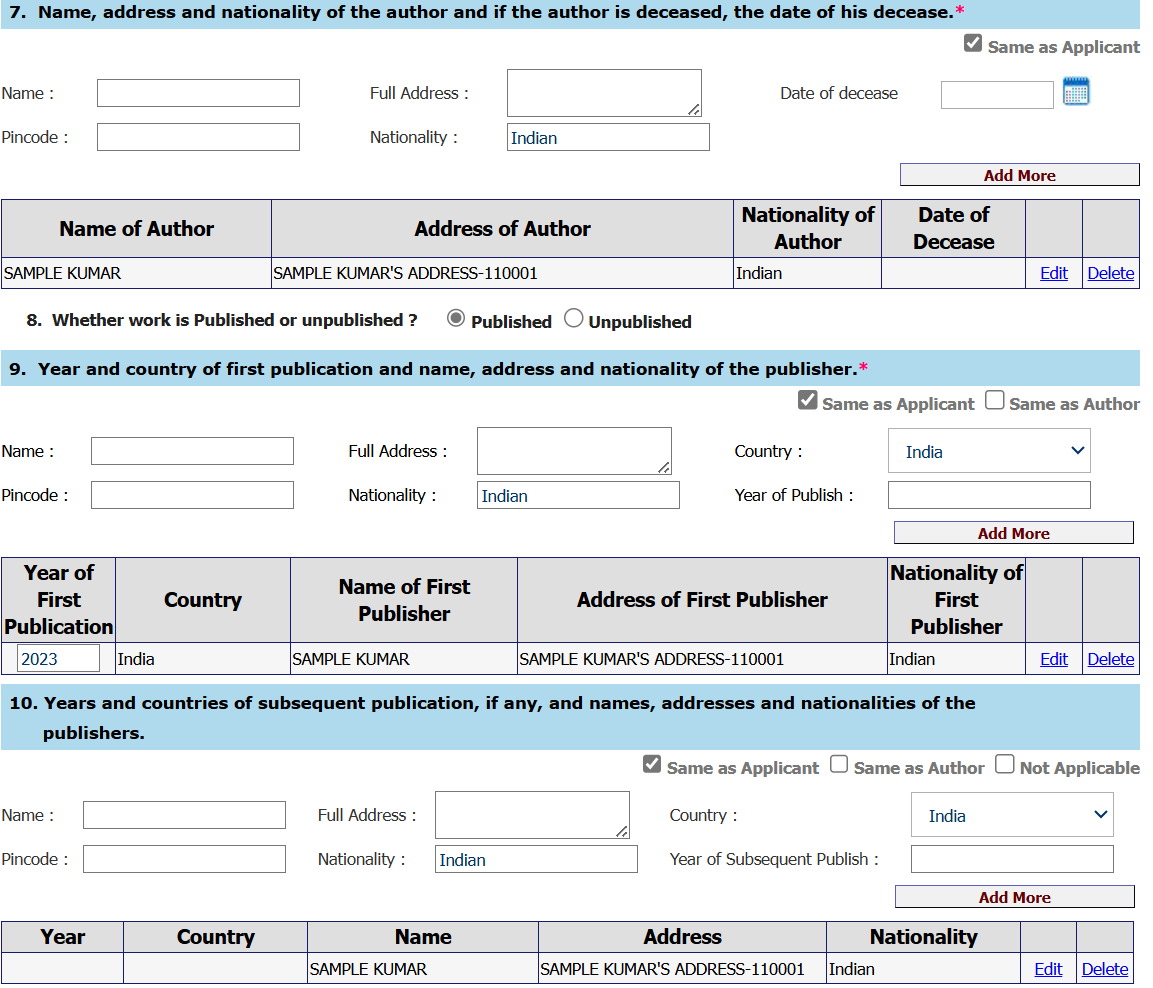
Under Sr No.7, enter the particulars of the Author. In case the author is no more, you have to mention the date on which the author passed away. Under Sr No.8 details of Publication are to be mentioned. Publication refers to displaying or exhibiting the work in Public. In case the work is published, click on Published, if not, clicked on Unpublished and you won’t have to fill any more details. In case your work is published, you have to Fill in Sr No.9 & 10 where it will ask you for the same details + the year on which the work was published. You can mention all the truthful particulars here. If the work is published multiple times, you can add Details of Subsequent Publication as well.
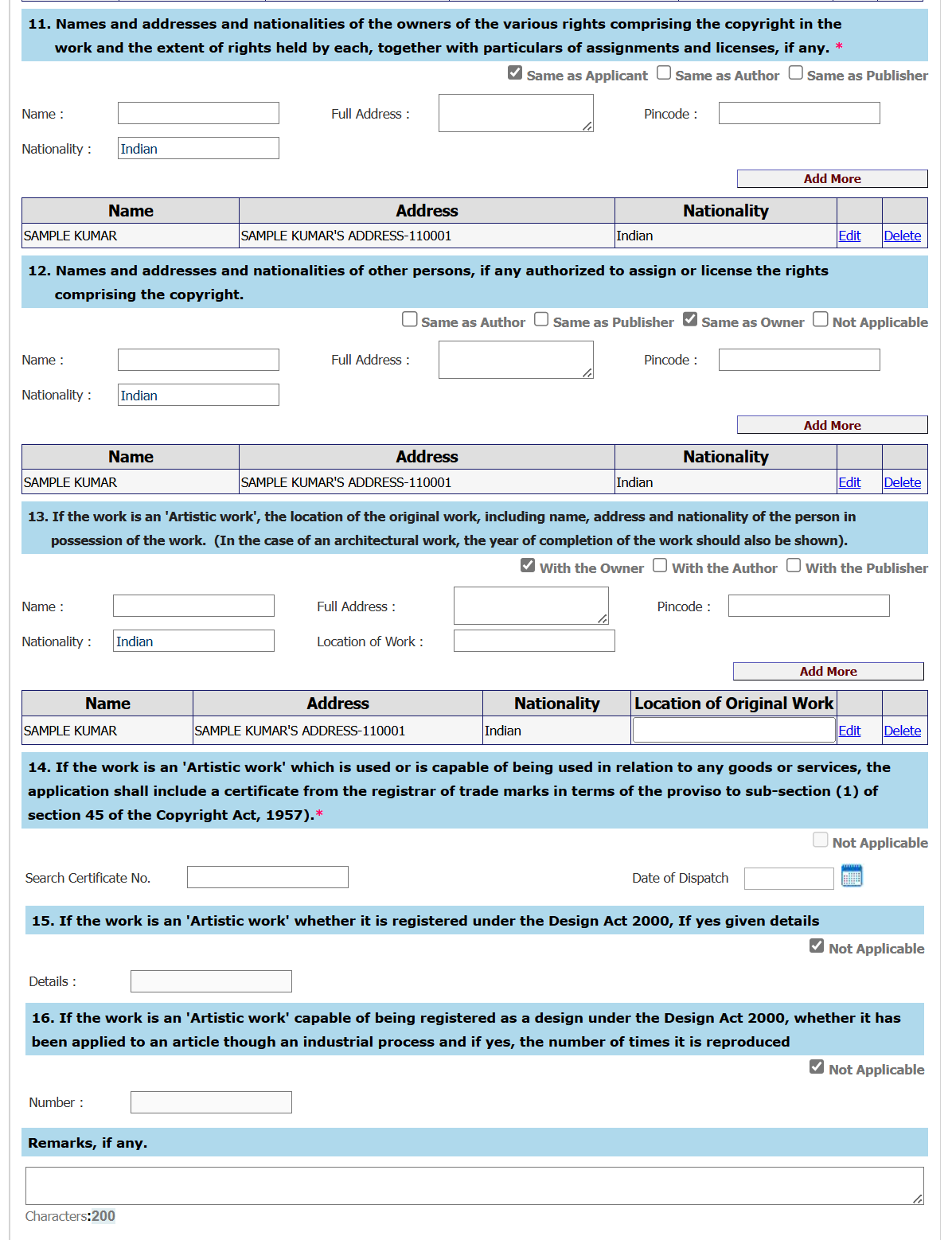
Fill in the rest of the application in the manner you filled the prior details. Remember, in case there are multiple right holders, you can add details of multiple applicants by simply going back to the relevant serial number and entering one more and clicking on ‘Add More’ Then Click on Save
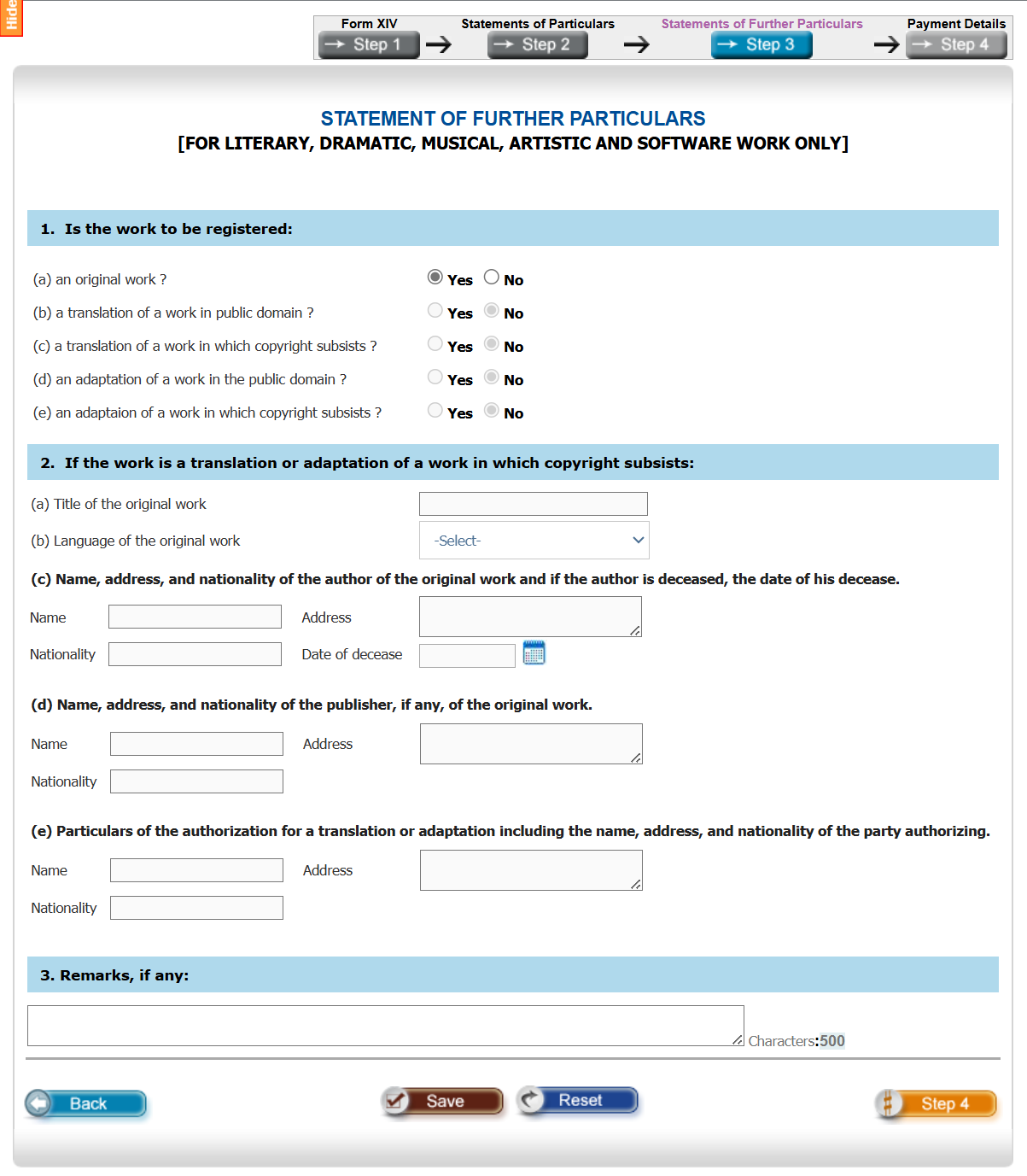
You will be redirected to Statement of Further Particulars Generally, when you are applying for copyrights, it would be an original work. As such you are required to select ‘YES’ at Sr no.1(a).
However, in case your work is derived from some other work which was already available in the public domain or in which copyright subsists either by the way of translation, or is an adaptation of the work in public domain or adaptation of work in which copyright subsists, then you have to select the relevant option. In this case, you have to duly provide a notice to the interested party and provide them with the particulars of your draft copyright application along with a full disclosure.
Additionally, in case the works is a derivative work, then particulars of the said original work have to be mentioned under Sr No.2.
Then click on SAVE. You will be proceeded on to the next step.
Voila! You have completed your copyright application.
Pay the Fee After filling out the form as above, you’ll be directed to the payment section. The fees for copyright registration vary depending on the type of work, but for most categories, it’s quite affordable. You can pay online using a debit card, credit card, or net banking. Once the payment is made, you’re almost done!
Government Fee for Copyright Applications, depending upon the work and type of application are mentioned herewith.
Sl.No.
Item
Fee
1
For a license to republish a Literary, Dramatic, Musical or Artistic Work (sections 31, 31A, 31B* and 32A).
Rs. 5,000 per work
2
For a license to communicate any work to the public by Broadcast [section 31(1)(b)].
Rs. 40,000 per applicant/per station
3
For a license to republish a Cinematograph Film (section 31).
Rs. 15,000 per work
4
For a license to republish a Sound Recording (section 31).
Rs. 10,000 per work
5
For a license to perform any work in public (section 31)
Rs. 5,000 per work
6
For a license to publish or communicate to the public the work or translation (section 31A).
Rs. 5,000 per work
7
For a license to publish any work in any format useful for a person with disability (section 31B).
Rs. 2,000 per work
8
For an application for a license to produce and publish a translation of a Literary or Dramatic work in any language (sections 32 and 32A).
Rs. 5,000 per work
9
For an application for registration of copyright in a-(a)Literary, Dramatic, Musical or Artistic Work(b)Provided that in respect of 1[***] Artistic work which is used or is capable of being used in relation to any goods 2[or services](section 45).
Rs. 500 per work Rs. 2,000 per work
10
For an application for change in particulars of copyright entered in the Register of Copyrights in respect of a :(a) Literary, Dramatic, Musical or Artistic Work(b) Provided that in respect of 3[***] Artistic work which is used or is capable of being used in relation to any goods 4[or services] (section 45).
Rs. 200 per work Rs. 1,000 per work
11
For an application for registration of copyright in a Cinematograph Film (section 45).
Rs. 5,000 per work
12
For an application for registration of changes in particulars of copyright entered in the Register of Cinematograph Film (Section 45).
Rs. 2,000 per work
13
For an application for registration of copyright in a Sound Recording (section 45).
Rs. 2,000 per work
14
For an application for registration of changes in particulars of copyright entered in the Register of Copyrights in respect of a Sound Recording (section 45)
Rs. 1,000 per work
15
For taking extracts from the Register of Copyrights (section 47).
Rs. 500 per work
16
For taking extracts from the indexes (section 47).
Rs. 500 per work
17
For a certified copy of an extract from the Register of Copyrights or the Indexes (section 47)
Rs. 500 per work
18
For a certified copy of any other public document in the custody of the Registrar of Copyrights or Secretary of the Copyright Board.
Rs. 1200 per work per place of entry
Remember, you may be required to submit documents and applications offline as well for which you may require drafts of the applications in Word Format so that you can easily fill them up and submit them.
Download the Copyright Application formats in easily editable word format by filling the form below
After the payment, you will receive 2 documents
Form XIV, Statement of Particulars & Statement of Further Particulars: This contains all your declarations made in the online form. A Diary Number will be issued to you and it will be mentioned on the top right hand corner of your filed application. This will be your application number and using this, you will be able to track the status of your copyright application
Acknowledgement/ Receipt: This is your payment acknowledgement. You have to send it your copyright application. This serves as a proof that you have paid the relevant fee.
Upload Documents and Submit Lastly, you’ll need to upload supporting documents (we’ll cover these in detail next) and hit submit. After that, you’ll receive an acknowledgment from the Copyright Office, and the real waiting game begins!
These are the documents required for copyright registration.
Type of Work
Document to be submitted By Post/ By Hand/ Online Filing
Artistic
2 Copies of work DD/IPO of Rs. (as applicable) per work NOC from the author if the applicant is different from the author. NOC from publisher if work published and publisher is different from applicant. Search Certificate from Trade Mark Office (TM -60) if the work is being used on goods or capable of being used on the goods. NOC from a person whose photograph appears in the work. If the application is being filed through attorney , a specific Power of Attorney in original duly signed by the applicant and accepted by the attorney
Cinematograph Film
2 Copies of work DD/IPO of Rs. (as applicable) per work NOC from various copyright holders or copy of agreement (deed of assignment). NOC from publisher if work published and publisher is different from applicant. If the application is being filed through attorney , a specific Power of Attorney in original duly signed by the applicant and accepted by the attorney
Music
2 Copies of work (Graphical Notes) DD/IPO of Rs. (as applicable) per workNOC from publisher if work published and publisher is different from applicant.NOC from the author if the applicant is other than the author. If the application is being filed through attorney , a specific Power of Attorney in original duly signed by the applicant and accepted by the attorney
Literary/ Dramatic
2 Copies of work DD/IPO of Rs. (as applicable) per work NOC from the publisher if the applicant is other than the publisher and work is published. NOC from the author if the applicant is other than the author. If the application is being filed through attorney , a specific Power of Attorney in original duly signed by the applicant and accepted by the attorney
Sound Recording
2 Copies of work DD/IPO of Rs. (as applicable) per work NOC from various copyright holders or copy of agreement (deed of assignment). NOC from publisher if work published and publisher is different from applicant. If the application is being filed through attorney , a specific Power of Attorney in original duly signed by the applicant and accepted by the attorney
Software
2 Copies of work DD/IPO of Rs. (as applicable) per work NOC from the author if the author is different from the applicant. NOC from the publisher if work is published and the publisher is different from the applicant. If the application is being filed through attorney , a specific Power of Attorney in original duly signed by the applicant and accepted by the attorney Source code and object code of work for verification.
Timelines and Expectations: How Long Does It Take?
After you’ve submitted your application, you might be eager to get that official copyright certificate in your hands. But like most legal processes, it takes some time. So, how long can you expect to wait?
Waiting Period After you’ve submitted your application and upload your documents, it enters a 30-day mandatory waiting period. Further, under Rule 70 of the Copyright Rules, 2013, your application gets published in the relevant monthly journal and in case no third-party objections are received, your application is proceeded forward.
Scrutiny After the Mandatory Waiting Period, Copyright Registry checks your application and if there’s an issue with your application—like missing documents, misdeclaration or non-declaration, the Copyright Office will notify you. You’ll then have a chance to respond to these objections and clarify your case. This is called a Reply to Scrutiny Report.
Re-scrutiny After your reply is submitted, the Copyright Registry, if satisfied by your reply, will proceed with the application for registration. However, in case they are not satisfied, they will issue a Rescrutiny report and you will have to reply to the same.
Hearing In case the Copyright Registry is not satisfied with your reply, they will appoint a hearing which you will have to attend and present your case.
Issuance of Certificate If everything is smooth sailing, you can expect your copyright certificate to be issued within 6 to 12 months.
Track Your Copyright Application Status
Now, you’ve done all the hard work—submitted your application, uploaded documents, and paid the fee. But what if you want to check where your application stands? Thankfully, the Copyright Office provides an easy way to track your status online.
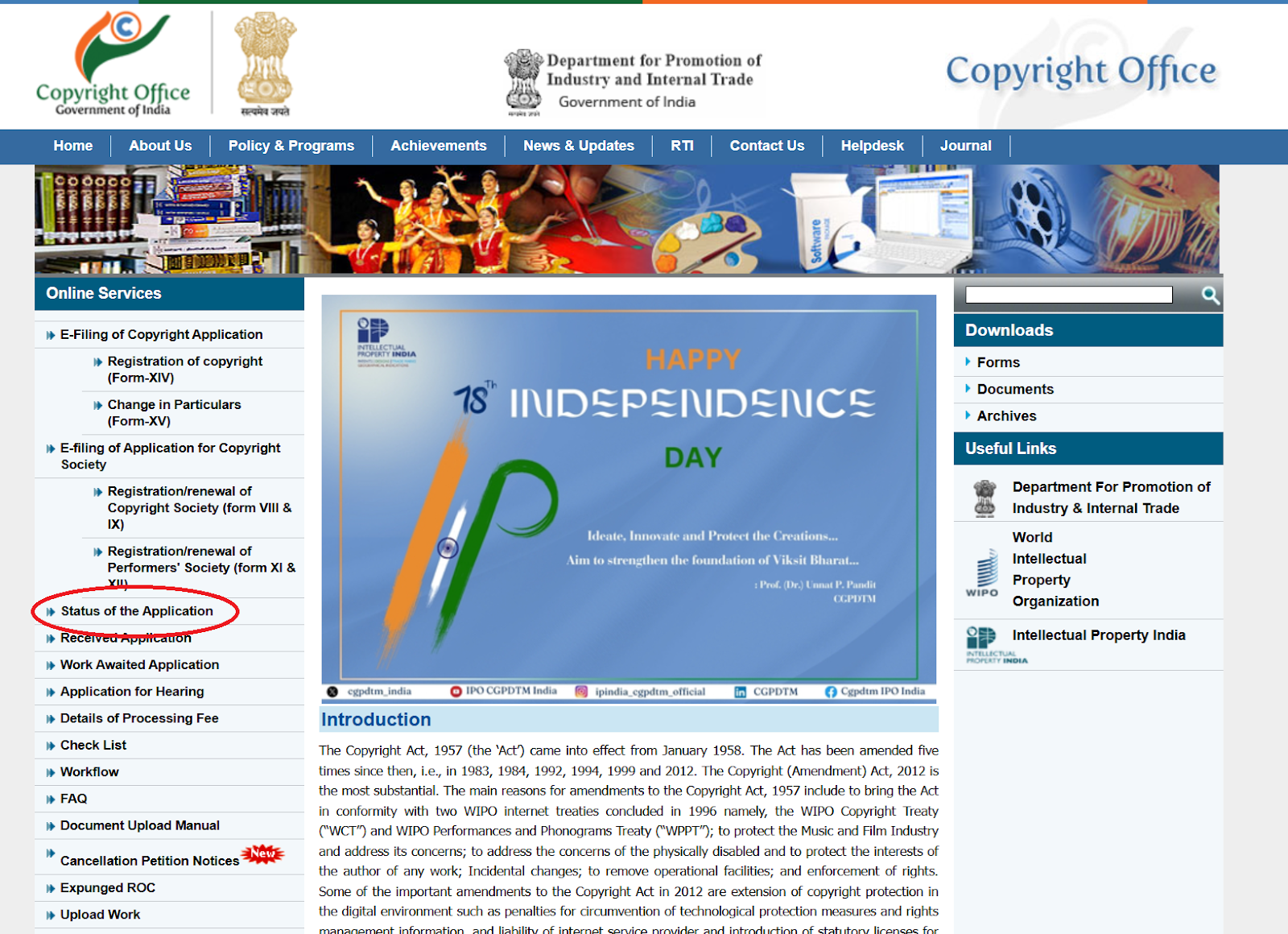
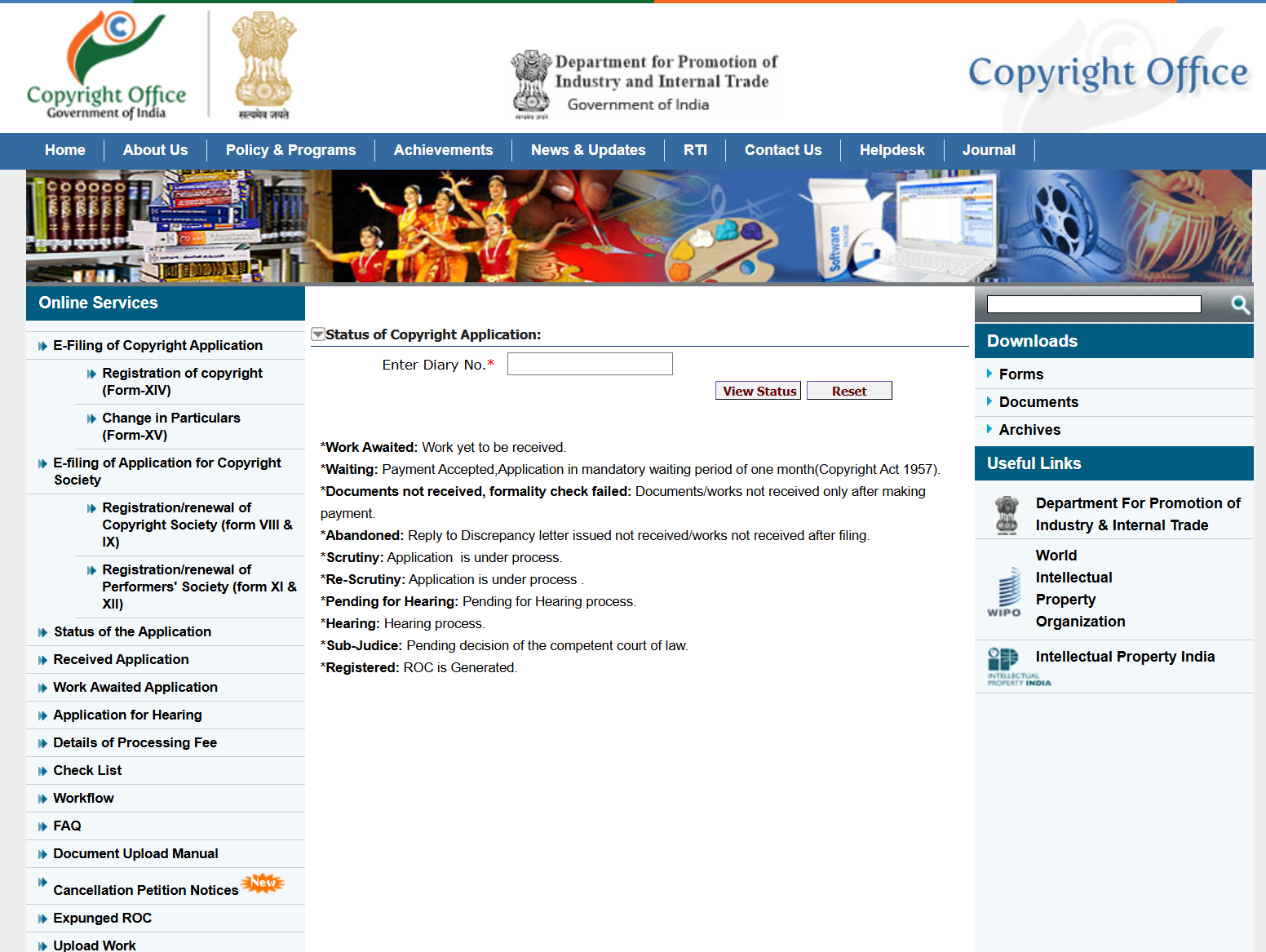
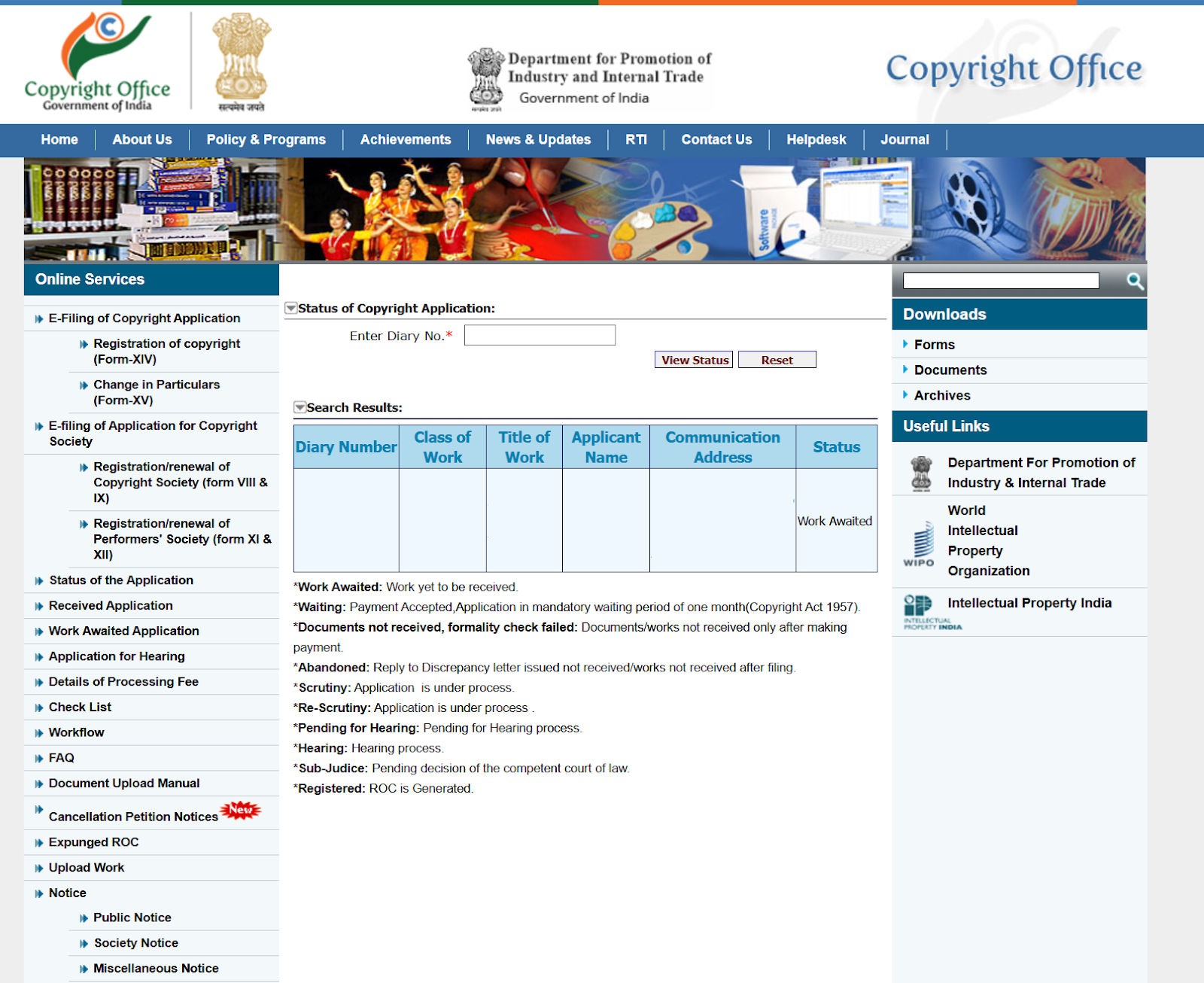
Visit the Copyright Office Website Head over to the official Copyright Office website again. There’s a section dedicated to tracking applications, so you can keep tabs on yours without having to call or email anyone. You can directly track your status through the link below https://copyright.gov.in/frmStatusGenUser.aspx
Enter Your Diary Number When you first submitted your copyright application, you received a unique application number called a Diary number. Just enter that number into the tracking system on the website.
Check Updates The system will tell you where your application is in the process—whether it’s still under scrutiny, if there are any objections, or if it’s approved and awaiting certificate issuance. This can save you a lot of anxiety by giving you regular updates on your application status.
In conclusion, applying for copyright in India is relatively straightforward if you follow the steps carefully. With the right documents, a bit of patience, and an eye on the timelines, you’ll have your work protected in no time. So go ahead, get that copyright and rest easy knowing your creative work is legally secure!
Copyright FAQs: Everything You Need to Know, Simplified!
Whether you’re an artist, writer, musician, or any kind of creator, copyright can feel like a complex topic. So, it’s totally understandable if you have questions about how it works and why it’s important. In this Copyright FAQs section, we’ll answer the most common queries about copyright in India. Don’t worry we’ll keep it simple, clear, and even a little fun! You’ll walk away feeling confident about what copyright is and how it applies to you.
Q: What exactly is copyright? Copyright is a legal protection given to creators of original works like books, songs, films, paintings, and even software. When you own the copyright to your work, you have the exclusive right to reproduce, distribute, and perform it. It essentially means that no one can use your creation without your permission.
Imagine spending months writing a novel, and then someone else starts selling copies of it without even asking! That’s what copyright prevents. So, whether you’re an author or a photographer, having copyright ensures your hard work is legally protected, and that only you can decide how your creation is used.
Q: Do I automatically get copyright when I create something? Yes! In India, copyright protection starts the moment you create your work and fix it in a tangible form. You don’t even have to register it to have basic protection, although registration strengthens your case in case of disputes. So, as soon as you finish that blog post, song, or artwork, copyright is on your side even if you don’t file any paperwork!
Q: Is my idea copyrightable? Nope! Ideas, concepts, and thoughts by themselves are not protected by copyright. For example, if you have a brilliant idea for a movie but haven’t written the script yet, copyright won’t cover that idea. You need to actually put your idea into some physical form a screenplay, painting, or recording for it to be protected.
Q: How long will my copyright protection last? Great question! In India, copyright protection for most works lasts for the creator’s lifetime plus 60 years after their death. So, if you write a best-selling novel, your copyright protection will last your entire life, and then for 60 years after you pass away. During this period, your heirs or estate can continue to benefit from the work.
For other types of work, like sound recordings or films, copyright protection lasts for 60 years from the date of publication. So, if you’ve just released an album, rest assured it’s protected for the next six decades!
Q: Can I extend my copyright beyond that? Unfortunately, no. Once the 60-year posthumous period is up, the work enters the public domain, meaning anyone can use it without needing permission. Think of Shakespeare’s plays or classic movies like Gone with the Wind, they’re in the public domain because their copyrights have expired, allowing anyone to reproduce or adapt them freely.
Q: What happens if I don’t register my copyright? While copyright exists automatically, registering it gives you additional legal benefits. Without registration, you can still claim ownership, but if someone challenges you in court, having a registered copyright certificate makes your case much stronger. It acts as official proof that you’re the rightful owner. So, while it’s not mandatory, it’s a smart move if you want to safeguard your work from potential legal issues.
Q: Can I sell my copyright to someone else? Yes, you can! Copyright is a form of property, and just like you can sell your house, you can transfer or sell your copyright. When you do this, the new owner gets the exclusive rights to use the work, just like you had. However, even after selling it, you’ll still retain your moral rights. That means your name will stay associated with the work, and no one can modify it in a way that harms your reputation.
Q: Can I license my copyright instead of selling it? Absolutely. Licensing is when you give someone permission to use your work for specific purposes, but you still retain ownership of the copyright. For example, if you’ve written a book, you could license the movie rights to a filmmaker while keeping the rights to sell copies of the book. Licensing is often a better option for creators who want to maintain control over their work while still making money from it.
Q: What if I want to transfer my copyright after my death? You can specify in your will who will inherit your copyright. This way, your heirs can continue to benefit from your work after you’re gone. For instance, if you’re a musician, you might want your family to collect royalties from your songs even after your death. Make sure to clearly state this in your will to avoid any disputes later on.
Q: What can I do if someone steals my work online? The internet makes it super easy for content to be copied or misused. If you find someone using your work without permission, you can take action by sending a cease-and-desist letter, filing a Digital Millennium Copyright Act (DMCA) notice (for content on international platforms), or even suing them for copyright infringement. The Indian Copyright Act is also applicable to online content, so you’re covered!
Q: How do I stop plagiarism on social media? Plagiarism is a growing issue on social media, but you can protect yourself by registering your work and keeping original files with timestamps. Many platforms, like Instagram and YouTube, have built-in copyright complaint systems where you can report any unauthorized use of your content. If your post or video is copied, you can file a complaint, and the platform will usually take it down.
Q: Can I copyright a social media post? Yes! As long as it’s an original creation, social media posts are eligible for copyright protection. So whether it’s a poem, a photograph, or even a meme you made, if it’s your original work, you own the copyright. You can register your posts for extra security, but as with all works, copyright exists from the moment of creation.
Conclusion
In a world bursting with creativity and innovation, understanding copyright is essential for every artist, writer, musician, and creator. This powerful legal tool not only protects your hard work but also empowers you to control how your creations are used and shared. Whether you’re crafting a story, composing a song, or designing a new product, copyright ensures that your unique vision is safeguarded against unauthorized use.
We’ve explored the ins and outs of copyright from the application process to frequently asked questions about your rights. Remember, while copyright automatically protects your work upon creation, registering it provides additional legal benefits that can prove invaluable in disputes. Knowing how to navigate the copyright landscape helps you make informed decisions about selling, licensing, or transferring your rights.
As you embark on your creative journey, keep in mind that copyright is not just a legal term; it’s a way to nurture and sustain your artistic endeavours. So, take the necessary steps to protect your intellectual property, stay informed, and keep creating with confidence! Whether you’re just starting or are a seasoned creator, understanding copyright can secure your creative future and ensure that your hard work is recognized and rewarded. Embrace your creativity and let copyright work for you!
Benefits and importance of GST for New Businesses: Tax Advantages for Early-Stage Companies
Starting a new business is an exciting journey full of opportunities and challenges, but one thing you definitely don’t want to overlook is your tax setup. This is where GST Registration can play a huge role in making your entrepreneurial path smoother. If you’re wondering why GST matters for new businesses, the answer is simple: it offers a range of tax benefits that help you manage costs, streamline operations, and grow your company without unnecessary headaches. Let’s dive into some of the major perks that GST brings to the table for early-stage businesses!
Simplified Tax Structure: One Nation, One Tax
Remember the days when businesses had to deal with a confusing web of taxes like VAT, service tax, and excise duty? Well, one of the biggest benefits of GST (Goods and Services Tax) is that it has replaced all these multiple taxes with a single, unified tax system. Whether you’re selling goods or providing services, you only need to worry about GST. For new businesses, this means less paperwork, fewer tax returns to file, and less time spent on managing different taxes.
The simplified tax structure of GST makes life a lot easier for startups. You no longer have to navigate the complexities of state-specific taxes or worry about the different rates for goods and services. GST offers a straightforward approach where everything is under one umbrella, so you can focus more on growing your business and less on tax compliance. Plus, it reduces the chances of errors in tax filings and helps you avoid penalties down the line.
Input Tax Credit (ITC): Save More, Spend Smarter
One of the best perks of GST Registration is the Input Tax Credit (ITC). In simple terms, ITC allows you to claim credit for the GST you’ve paid on business-related purchases, such as raw materials, equipment, or even rent. Instead of paying tax on the entire sale amount, you only need to pay GST on the value your business adds. This reduces your overall tax burden and keeps more money in your pocket, which is crucial for a new business.
For example, let’s say you buy office furniture or machinery to kickstart your business. The GST you pay on those purchases can be deducted from the GST you charge your customers. Essentially, you’re not being taxed twice on the same transaction, which saves you a lot of money in the long run. This advantage can help startups reinvest in their growth and boost profitability in the early stages when every penny counts.
Without GST Registration, you wouldn’t be able to claim ITC, which means higher costs and lower margins. So, getting registered early ensures you’re making the most of this tax-saving opportunity from the get-go.
Ease of Doing Business: Interstate Trade Made Simple
If you have big plans for your startup, you’re probably thinking about scaling up and expanding beyond your local market. That’s where GST Registration can be a game-changer. Under the previous tax system, interstate trade in India was complicated due to various state taxes and border levies, making it difficult for businesses to expand across state lines. But with GST, it’s now much simpler to do business anywhere in the country.
Since GST is a single, nationwide tax, it has removed the barriers to interstate trade. Whether you’re selling products in Delhi or delivering services in Bangalore, you only need to comply with one tax system. This streamlined process makes it easier for startups to explore new markets and expand their customer base without worrying about the complexities of managing different state taxes.
Additionally, because GST applies uniformly across the country, you don’t have to worry about varying tax rates or compliance rules in different states. This consistency makes it easier to plan your expansion strategy and ensures you can do business anywhere in India with minimal hassle.
Increased Credibility: Attracting Customers and Investors
When you’re running a new business, building trust with customers and investors is critical to your success. One of the often-overlooked benefits of GST Registration is the credibility it brings to your company. Being GST-registered signals to the world that your business is legitimate, compliant with tax laws, and ready for growth. Customers are more likely to trust a business that’s GST-registered because it shows you’re transparent and professional.
Not only that, but potential investors also see GST Registration as a sign of seriousness. Investors want to know that the startups they’re backing are playing by the rules, and being GST-compliant gives them confidence that your business is on the right track. It’s a simple step that can boost your reputation and open doors to bigger opportunities – whether that’s landing a new client or securing funding to scale your startup.
Tax Relief for Small Businesses: The Composition Scheme
If your business is still in its infancy and has an annual turnover of less than ₹1.5 crore*, you can benefit from a special provision under GST known as the Composition Scheme. This scheme allows small businesses to pay a lower, fixed rate of GST on their sales instead of the regular rates. You can also file quarterly returns instead of monthly ones, making the compliance process a lot more manageable for early-stage companies.
The Composition Scheme is designed to help small businesses by reducing their tax burden and simplifying the filing process. If your startup qualifies, opting into this scheme can save you time and money, both of which are crucial when you’re trying to get your business off the ground. Keep in mind that while the scheme offers reduced taxes, businesses under this scheme cannot claim Input Tax Credit. So, it’s important to weigh the pros and cons based on your business needs.
* Turnover limit is subject to conditions and change by the GST Authorities.
Legal Compliance: Avoiding Penalties and Headaches
Let’s be real – nobody wants to deal with legal hassles, especially when you’re trying to get your startup off the ground. But skipping GST Registration when you’re required to get it can lead to hefty penalties and unwanted scrutiny from tax authorities.
Once your turnover crosses the Rs.40 lakh threshold for goods suppliers, for those providing services the registration threshold is Rs.20 lakh GST Registration becomes mandatory (The turn over limit is as of Oct 2024 this may vary according to new guidelines present that time). If you continue operating without it, you’re inviting penalties that can go up to 10% of the tax amount, with a minimum of ₹10,000. In more serious cases, it could even lead to prosecution. Not exactly the kind of attention you want as a budding entrepreneur, right?
Registering for GST from the get-go ensures that you stay on the right side of the law. It’s one less thing to worry about, and it keeps your business operations smooth and stress-free. Plus, being compliant from the start means you won’t have to deal with complicated paperwork or retroactive filings later on, which can be a real headache.
Selling on E-Commerce Marketplaces:
Compulsory for E-Commerce Sellers: Popular e-commerce platforms like Amazon, Flipkart, and others often mandate that sellers must have a GST registration. Without it, sellers may not be allowed to list their products or services on these platforms.
Facilitates Seamless Operations: E-commerce operators are required to collect tax at source (TCS) at 1% under GST law. Registered sellers are required to file the appropriate returns to claim credit for this TCS. This ensures that the tax credit is not lost and reduces the cost burden on sellers.
GST is a Boon for New Businesses
In the fast-paced world of startups, GST Registration offers multiple benefits that can give you a competitive edge. From simplifying the tax structure and saving you money through Input Tax Credit to making interstate trade easier and boosting your credibility, GST is designed to help businesses like yours thrive. Whether you’re a small business just starting out or you have plans to scale rapidly, the advantages of GST are hard to ignore.
So, don’t wait until your turnover crosses the threshold – consider registering for GST early on to take full advantage of the benefits. It’s a smart move that can set your startup on a path to long-term success and keep you focused on what really matters: building your business
Composition Scheme: Eligibility and Benefits for Small Businesses
If you’re a small business owner looking for a simplified way to handle GST Registration, the Composition Scheme might be exactly what you need. Designed to make life easier for small businesses, the scheme offers lower tax rates and reduces the compliance burden, giving you more time to focus on growing your business rather than worrying about complex GST filings. But before you dive in, it’s important to understand who qualifies and what the real benefits are.
In this section, we’ll break down the eligibility criteria for the Composition Scheme and walk you through the advantages it offers. It’s all about keeping things simple and manageable, especially for businesses just starting out.
Eligibility for the Composition Scheme: Who Can Join?
First things first, let’s talk eligibility. The Composition Scheme is specifically designed for small businesses with a turnover of up to ₹1.5 crore in most states. If your business is based in a northeastern state or one of the special category states, the turnover threshold is a bit lower—₹75 lakh. So, if your annual turnover falls within this range, you can opt for this scheme and enjoy its perks.
The scheme is ideal for businesses like small retailers, manufacturers, and restaurants that operate locally and don’t need to deal with complicated GST filings every month. However, not all businesses can enroll. If you’re involved in making inter-state sales, supplying goods through an e-commerce platform, or engaged in services other than restaurants, you’re not eligible for the Composition Scheme. It’s also worth noting that businesses that deal with exempted goods or services can’t opt for this scheme either.
Before you sign up, check if your business qualifies and whether it makes sense for your operations. The last thing you want is to enroll and later realize you’re not eligible!
Simplified Tax Rates: Lower Your Tax Burden
One of the biggest advantages of the Composition Scheme is the lower tax rates. Instead of paying the standard GST rates, you pay tax at a reduced rate on your turnover. For manufacturers and traders, the rate is 1%, while restaurant service providers pay 5%. This reduced rate can significantly lower your tax burden, especially when compared to the higher GST rates applicable to regular taxpayers.
But there’s a trade-off. Under the Composition Scheme, you cannot collect GST from your customers or issue tax invoices. This means you pay the GST out of pocket based on your turnover. For businesses that deal primarily with consumers (B2C), this arrangement works well because consumers usually don’t care about claiming Input Tax Credit (ITC). But if you’re planning to sell to other businesses (B2B), this could be a disadvantage since they won’t be able to claim ITC on purchases from you.
Simplified Compliance: Less Paperwork, More Focus on Growth
One of the main reasons small businesses opt for the Composition Scheme is the simplified compliance. Under regular GST rules, you’d be required to file multiple returns every month, keep detailed records, and reconcile invoices—tasks that can eat up a lot of your time and resources. With the Composition Scheme, the compliance burden is much lighter.
You only need to file quarterly returns instead of monthly ones, which means less paperwork and fewer deadlines to stress over. This simplicity allows you to spend more time focusing on running and growing your business instead of worrying about tax compliance. You also don’t need to worry about issuing tax invoices. Instead, you provide a bill of supply to your customers, which is much simpler and easier to manage.
For small businesses, particularly those without a dedicated accounting team, this reduction in compliance can be a game-changer. You’ll be able to manage your GST obligations without needing to hire a tax expert or invest in expensive accounting software.
Who Should Opt for Composition Scheme?
Now that you know the basics, let’s talk about who should consider opting for the Composition Scheme. If your business has a local customer base and doesn’t deal with other businesses that require tax invoices, this scheme could be a great fit for you. It’s especially beneficial for small retailers, manufacturers, and service providers like restaurants who want to keep things simple.
However, if your business is looking to grow beyond the local market, the scheme might not be the best option. For example, if you plan to expand across state borders or sell on e-commerce platforms, you won’t be eligible for the Composition Scheme. Similarly, if you’re working with other GST registered businesses, they may prefer to work with regular taxpayers who can issue tax invoices and allow them to claim Input Tax Credit.
The Trade-Off: Lower Tax, But No Input Tax Credit
While the Composition Scheme offers lower tax rates and easier compliance, it comes with one significant downside—you can’t claim Input Tax Credit (ITC) on your business expenses. ITC allows regular GST taxpayers to reduce their tax liability by offsetting the GST paid on their purchases against the GST collected on sales. Without ITC, you’ll need to bear the full cost of GST on any goods or services you buy for your business.
For many small businesses, this trade-off is worth it because the overall tax savings and simplified compliance outweigh the loss of ITC. But if your business has significant GST paid expenses or works closely with other GST registered businesses, you might want to reconsider whether the Composition Scheme is the right choice.
Simplifying GST for Small Businesses
The Composition Scheme is a great option for small businesses looking to simplify their GST Registration and compliance. With lower tax rates, less paperwork, and fewer deadlines, it’s designed to make life easier for businesses with limited resources. However, the scheme comes with trade-offs, such as the inability to collect GST from customers or claim Input Tax Credit.
Before you decide, weigh the pros and cons carefully based on your business model and future growth plans. If you’re looking to keep things simple and stay focused on what you do best, the Composition Scheme could be the perfect fit for your business!
How to Register Quickly as a Startup: Fast-Tracking Your GST Registration
Starting a new business is exciting, but let’s be honest – dealing with paperwork can be overwhelming, especially when it comes to GST Registration. Luckily, registering your startup for GST doesn’t have to be a drawn-out process. With a few smart moves and a little planning, you can fast-track your registration and get back to building your business. So, if you’re eager to avoid delays and simplify things, this guide is for you. Let’s explore some tips and tricks to help you breeze through GST Registration without any unnecessary stress.
Register Online: Simplifying the Process
Good news! You don’t have to visit any government offices or stand in long queues to get your GST Registration done. You can complete the entire process online from the comfort of your home or office. The official GST portal (www.gst.gov.in) is where you’ll need to
head for registering. The online process is straightforward, user-friendly, and designed to help you complete the registration quickly.
Inception
To begin, create an account on the GST portal and generate a Temporary Reference Number (TRN).
Fill in the details in the simple form. You will receive two OTPs, one on your mail and the other on your mobile phone, enter both and Voila! You have taken the first step towards your GST Registration. You will be granted a Temporary Reference Number (TRN) which will be sent to you on your mail. Use this TRN for further processes.
This TRN will help you save your progress in case you need to pause midway through the application. Once you’ve logged in, fill in the required details – business information, promoter details, authorized signatory, principal place of business, and more.
Here’s a tip to speed up the process: double-check your information before submitting. Small errors like incorrect business names, typos in PAN numbers, or incomplete address details can lead to delays or rejection of your application. So, make sure every detail is accurate and matches the information on your supporting documents. A little extra caution upfront will save you from having to reapply later.
Now Go to www.gst.gov.in >> Register>> Temporary Reference Number (TRN). Login in to the portal by entering the TRN you received on your mail, enter the captcha. You will receive one OTP on your Mail ID & Mobile Number, enter either one of them and move forward.
Once you are logged in, click on the Pencil Icon, under the Action Tab
You will be redirected to an extensive form, under the following tabs. Take your time and fill every single one of them truthfully and based upon the facts, registrations and details readily available with you.
After you fill the form, you will be asked to sign the form. There are two options, either you can choose the easy one i.e. AADHAAR Authentication wherein an OTP is sent to the Authorized Signatory’s AADHAAR Linked Mobile Number and then the form is submitted or you can sign the form with DSC for which you have to follow the following guide https://tutorial.gst.gov.in/userguide/loginanddsc/Register___Update_DSC.htm
After you sign the form, a Success page will appear.
Thereafter, anywhere within 24-48 Hours normally, you will receive a link for AADHAAR Authentication on your mail. You have to click on it and it will be redirected to a page where you have to enter the AADHAAR of the Authorized Signatory and enter the OTP. Once successful, you have successfully filed your GST Registration Application.
Acknowledgment of Application: Once you submit the application for GST registration (Form GST REG-01) on the GST portal, you will receive an Acknowledgment Reference Number (ARN). This ARN can be used to track the status of your application on the GST portal.
In case of any queries, please feel free to consult our experts at TMWala either through our Website legalguruindia.com/ or our mail help@tmwala.com or through WhatsApp @ +91-7225090650.
Track Your Application Status: Stay on Top of the Process
Once you’ve submitted your application, don’t just sit back and wait for things to happen. To ensure a quick registration, it’s essential to track the status of your GST Registration online. The GST portal allows you to keep an eye on your application and check if any action is required from your end. You can use the ARN (Application Reference Number) provided after submission to track your application.
Sometimes, authorities may ask for additional documents or clarifications. If that happens, respond quickly to avoid any delays. The faster you respond, the sooner your application will be processed. Delays in response can slow things down, so always keep an eye on your email and the GST portal for updates.
If your application is approved, you’ll receive your GSTIN (Goods and Services Tax Identification Number) within a few days. Congratulations – you’re now GST-registered! But if there’s an issue with your application, don’t worry. You’ll get notified about what went wrong, and you can make the necessary corrections and reapply without too much hassle.
Register for GST Quickly and Get Back to Business
Getting your GST Registration done as quickly as possible is essential for any startup. Whether you’re selling products, offering services, or planning to scale across different states, being GST compliant keeps you on the right side of the law and opens up doors to business growth.
By gathering all your documents in advance, ensuring you fill out the online application accurately, considering TMWala’s help if needed, and tracking your status closely, you can speed through the registration process and get your GSTIN without unnecessary delays. The less time you spend on registration, the more time you can spend building your business and taking it to the next level. So, get organized, get registered, and get back to growing your startup!
Following documents may be required for GST Registration
CATEGORIES OF PERSON
DOCUMENT REQUIRED FOR FILING GST
Sole proprietor / Individual
PAN card of the owner Aadhar card of the owner Photograph of the owner (in JPEG format, maximum size – 100 KB) Bank account details Address proof
Partnership firm
PAN card of all partners (including managing partner and authorized signatory) Copy of partnership deed Photograph of all partners and authorized signatories (in JPEG format, maximum size – 100 KB) Address proof of partners (Passport, driving license, Voters identity card, Adhar card etc.) Adhar card of authorized signatory Proof of appointment of authorized signatory In the case of LLP, registration certificate / Board resolution of LLP Bank account details Address proof of principal place of business
Hindu Undivided Family (HUF)
PAN card of HUF PAN card and Adhar card of Karta Photograph of the owner (in JPEG format, maximum size – 100 KB) Bank account details Address proof of principal place of business
Company (Public/ Private/ Indian/ foreign)
PAN card of Company Certificate of incorporation given by Ministry of Corporate Affairs Memorandum of Association / Articles of Association PAN card and Aadhar card of authorized signatory. The authorized signatory must be an Indian even in case of foreign companies/branch registration PAN card and address proof of all directors of the Company Photograph of all directors and authorized signatory (in JPEG format, maximum size – 100 KB) Board resolution appointing authorized signatory / Any other proof of appointment of authorized signatory (in JPEG format / PDF format, maximum size – 100 KB) Bank account details Address proof of principal place of business
Limited Liability Partnership (LLP)
PAN card of all the partners Photographs of all the partners (JPEG format, up to 100 kb size) Partnership deed copy (showing names of all partners) Address proof of all the partners (e.g., Voter’s ID, Aadhaar card, etc.) Address proof of office (i.e., principal place of business) (e.g., property tax receipts, lease/rental agreement copy, utility bill etc.) Authorized signatory – Proof of appointment, Aadhaar card, Pan card Bank account details (e.g., canceled cheque, bank statements, etc.) For LLPs – Registration certificate, Board resolution of LLP For LLPs – Digital Signature Certificate
Private Limited Company
PAN Card of the company Certificate of Incorporation (issued by the Ministry of Corporate Affairs) PAN Cards of all directors Aadhar Card of the authorized signatory Photograph of all directors Proof of business address Bank account details Board resolution for the appointment of the authorized signatory Digital Signature Certificate (DSC) of the authorized signatory
Public Limited Company
PAN Card of the company Certificate of Incorporation (issued by the Ministry of Corporate Affairs) PAN Cards of all directors Aadhar Card of the authorized signatory Photograph of all directors Proof of business address Bank account details Board resolution for the appointment of the authorized signatory Digital Signature Certificate (DSC) of the authorized signatory
One Person Company (OPC)
PAN Card of the OPC Certificate of Incorporation (issued by the Ministry of Corporate Affairs) PAN Card and Aadhar Card of the director Photograph of the director Proof of business address Bank account details Digital Signature Certificate (DSC) of the authorized signatory
Trust/ Society/ Club/ NGO
PAN Card of the trust/society/club/NGO Registration Certificate of the trust/society/NGO PAN Cards of trustees/members Aadhar Card of the authorized trustee/member Photograph of the authorized person Proof of business address Bank account details Authorization letter for authorized signatory
Casual Taxable Person
PAN Card of the person Aadhar Card of the authorized signatory Proof of business address (if applicable) Bank account detail
Foreign Non-Resident Taxpayer
Passport copy of the authorized signatory Tax identification number (if issued by the country of origin) Proof of business address in India Bank account details in India Digital Signature Certificate (DSC)
Government Departments/Local Authorities
PAN Card of the department (if applicable) Proof of business address Authorization letter of the authorized signatory Bank account details Government-issued certificate or letter
Common Pitfalls Startups Face: Challenges to Avoid in GST Compliance
As a startup, you’re likely juggling a million things at once—product development, marketing, customer service, funding, and of course, GST Registration and compliance. But in the midst of all this, it’s easy to make mistakes that could slow you down or cost you money. The GST system is designed to simplify taxation, but it can still be tricky for new businesses if you’re not careful. In this post, we’ll go over some of the common pitfalls startups face when dealing with GST and how you can avoid them.
Delaying GST Registration: Procrastination Can Cost You
One of the most common mistakes startups make is waiting too long to complete their GST Registration. Many entrepreneurs assume they don’t need to register right away, especially if their turnover is below ₹40 lakh (The turn over limit is as of oct 2024 this may vary according to new guidelines present that time). While it’s true that registration is mandatory only when your business crosses a specific turnover threshold, waiting can actually hold you back in ways you might not expect.
For one, you won’t be able to claim the Input Tax Credit (ITC) if you’re not registered. ITC allows you to offset the GST you pay on your business purchases, which can significantly reduce your tax liability. Additionally, without a GST number, you might face challenges when dealing with other GST registered businesses, who may hesitate to engage with non-registered entities. So, even if you think you can wait, registering early can give your startup a smoother and more professional start.
Incorrect Filing of Returns: A Recipe for Penalties
Filing your GST returns incorrectly or missing deadlines is another common pitfall for startups. The GST system is designed to make things easy, but it also comes with specific deadlines that you must meet—whether it’s the monthly GSTR-1, GSTR-3B, or the annual GSTR-9. Many startups overlook these deadlines or file incomplete returns, which can lead to penalties.
If you miss filing on time, late fees start to add up quickly, and in some cases, you may even face interest on any unpaid tax. To avoid this, set up reminders or automate your filings with accounting software that supports GST compliance. Double-check all your figures before submitting returns to avoid mismatches, as errors can result in notices from the tax department and a lot of wasted time correcting them later.
Not Claiming Input Tax Credit Properly: Leaving Money on the Table
As a startup, every rupee counts, and one of the best perks of GST Registration is the ability to claim Input Tax Credit (ITC) on your business purchases. However, many new businesses either don’t know how to claim ITC properly or they forget to do it altogether, which is like leaving money on the table.
For instance, if you’ve purchased office equipment, raw materials, or even services like marketing from a GST registered vendor, you’re entitled to claim the GST you paid on those expenses as credit. The problem arises when startups fail to keep proper records or receipts, making it difficult to claim the credit later. To avoid this pitfall, keep thorough and organized records of all your GST paid purchases. Make sure that your suppliers are also filing their GST returns accurately, as any discrepancies could prevent you from claiming your rightful credit.
Incorrectly Classifying Goods or Services: Beware of Different Tax Rates
One more issue that startups often face is incorrectly classifying their goods or services under the wrong GST tax rates. Different goods and services are subject to varying tax rates, ranging from 0% to 28%, depending on their category. Misidentifying your offerings could lead to underpayment or over payment of GST, both of which can create complications down the line.
If you underpay, you might face fines and penalties, and if you overpay, you’re tying up funds that could be used elsewhere in your business. It’s crucial to ensure that your products or services are classified correctly from the start. You can consult with a tax professional or use GST classification tools available online to determine the appropriate tax rates for your offerings. It might take a little extra time, but it will save you a lot of trouble in the long run.
Ignoring Updates in GST Law: Stay Informed, Stay Compliant
The GST system is still evolving, and rules and regulations are regularly updated. Many startups make the mistake of not keeping up with these changes, which can lead to non-compliance without them even realizing it. Whether it’s changes in return filing dates, amendments in tax rates, or new compliance rules, staying updated with GST regulations is essential for running a compliant business.
One way to avoid this pitfall is to subscribe to newsletters from the GST portal, follow updates from government sources, or work with a professional who keeps an eye on these changes for you. Staying informed ensures you don’t accidentally break the rules and helps you make the most of any new benefits or schemes that could apply to your startup.
There are approximately 22 types of GST forms available. Among these, 11 forms are currently active, 8 are view-only, and 3 have been suspended. The specific forms a taxpayer must file depend on their registration type and business activities.
GST Returns
Description
Frequency
Due Date
GSTR-1
Details of outward supplies of taxable goods and/or services affected.
Monthly
11th of the next month.
Quarterly for those under QRMP scheme
13th day of the month after the quarter
IFF (Optional by taxpayers under the QRMP scheme)
Details of B2B supplies of taxable goods and/or services affected.
Monthly (for the first two months of the quarter)
13th of the next month.
GSTR-2(Suspended)
Monthly return form used to give the details of inward supply or purchases
15th of next month of the tax period
GSTR-3B
Summary return of outward supplies and input tax credit claimed, along with payment of tax by the taxpayer.
GST audit form for taxpayers with turnover exceeding Rs. 2 crores annually.
Annually
31st December of the year subsequent
Businesses registered under the Composition Scheme
GSTR-4
It is for Composition Scheme taxpayers. It applies to businesses with goods turnover up to Rs. 1.5 crores and service providers up to Rs. 50 lakhs, allowing them to pay tax at a predetermined rate.
Annually
30th April of the next financial year
GSTR-9A
GSTR-4 replaces quarterly submissions; taxpayers now file CMP-08 challans quarterly by the 18th.
CMP-08
Statement-cum-challan to make a tax payment by a taxpayer registered under the composition scheme under Section 10 of the CGST Act.
Quarterly
18th of the month succeeding the quarter.
Other types of business owners and dealers
GSTR-5
Mandated for non-resident foreign taxpayers conducting business in India, records their outbound and inbound transactions, adjustments, tax liabilities, and payments, submitted accordingly.
Monthly
For registrations less than 1 month, due within 7 days of expiry. For longer, due on the 20th or within 7 days of expiry.
GSTR-5A
It is a monthly summary for OIDAR service providers, due by the 20th.
Monthly
20th of next month.
GSTR-6
Input Service Distributors are required to file GSTR-6, detailing the ITC received and allocated, with comprehensive documentation on credit distribution.
Monthly
13th of the following month of the tax period
GSTR-7
Entities required to deduct TDS under GST must file GSTR-7, detailing deducted TDS, amounts due and paid, and any refunds.
Monthly
10th of the next month
GSTR-8
This form is mandatory for GST-registered e-commerce operators who collect tax at source. It documents all supplies made via the platform along with the corresponding TCS details.
Monthly
10th of the following month.
GSTR-9B
It is filed by e-commerce operators mandated to deduct Tax Collection at Source (TCS) under Section 52 of the CGST Act, 2017. It applies to operators facilitating sales where sellers differ.
Annually
GSTR-10
The last return required from a taxpayer after their GST registration has been canceled.
Once, when the GST registration is canceled or surrendered.
Date of order of cancellation, or within 3 months from the date of cancellation, whichever is later.
GSTR-11
A fluctuating tax return for taxpayers with UINs, detailing purchases by foreign embassies and diplomatic missions for self-use within a specific month.
28th of the following month in which the UIN holders receive the inward supply
ITC-04
A statement required from a principal or job-worker detailing goods sent to or received from a job-worker.
Yearly (for Annual Aggregate Turnover up to Rs. 5 crore) Bi-annually (for Annual Aggregate Turnover exceeding Rs. 5 crore)
25th April where AATO is up to Rs.5 crore.
25th October and 25th April where AATO exceeds Rs.5 crore.
Auto-drafted Returns
GSTR-2A
GSTR-2A is a dynamic, read-only return for purchasers, auto-filled with suppliers’ GSTR-1 and IFF data.
GSTR-2B
Introduced in August 2020, GSTR-2B is a static, read-only return providing ITC information from the previous month’s GSTR-1 filings, aiding purchasers in ITC claims.
GSTR-4A
Quarterly tax return for composition dealers, auto-generated from supplier GSTR-1, GSTR-5, and GSTR-7 data.
Tax Notice
GSTR-3A
A tax notice issued by the tax authority to a defaulter who has not timely filed monthly GST returns.
Note: The numbers are as of Oct 2024 this may vary according to new guidelines present that time.
Avoiding Common Pitfalls in GST Compliance
Navigating the world of GST Registration and compliance as a startup can feel a little overwhelming at first, but with the right knowledge and tools, you can avoid the most common pitfalls. Whether it’s registering early, staying on top of deadlines, claiming your Input Tax Credit, or keeping up with legal updates, a proactive approach will save you a lot of headaches.
By steering clear of these challenges, you’ll not only stay compliant but also position your startup for smoother operations and long-term growth. So, stay organized, double-check your filings, and remember – a little extra effort now can prevent major problems later!
In conclusion, GST registration is a game-changer for new businesses, offering a simplified tax structure that streamlines compliance and enhances credibility. By consolidating multiple taxes into one, GST registration reduces the financial burden on startups and helps them focus on growth. Benefits like the Input Tax Credit can significantly improve cash flow, allowing businesses to reinvest in their operations. Additionally, GST registration facilitates seamless interstate trade, making expansion easier and more efficient. For startups aiming to thrive, early GST registration is not just a smart move, but an essential step towards long-term success. Don’t wait—leverage the power of GST registration to boost your business today!
Use a TMWala: Get Help to Speed Things Up
If you’re not feeling confident about handling the GST Registration process on your own, don’t worry. TMWala experts are here who can assist you and make the process faster. From accountants to GST consultants, TMWala expert professionals have tons of experience with GST registrations and can help you avoid common pitfalls that slow things down.
Hiring TMWala means we will take care of everything – from filling out the forms to submitting your documents. We know exactly how to fast-track your application, making sure nothing is left incomplete or incorrect. While you’ll have to pay for the services, it’s often worth the cost, especially if you’re short on time or unsure about the technicalities of the process.
Another advantage of working with TMWala is that our experts stay updated on any changes in GST laws or requirements, ensuring your application is fully compliant. This is particularly helpful if you’re new to tax filings and don’t want to spend time studying the rules yourself.
When you’re starting a business, there’s a lot to think about—your product, your audience, your marketing. But one thing many startups tend to overlook is to file a trademark. Let’s be real, it might not seem like the most exciting part of launching your business, but trust me, it’s one of the smartest moves you can make. If you want to protect your brand and avoid future headaches, it is essential to file a trademark.
Whether you’re building the next big app or launching a quirky local bakery, your brand is what sets you apart from the competition. And that’s where trademarks come in—they make sure your brand stays yours. You wouldn’t want someone else to swoop in and steal your brand name after all your hard work, would you? So let’s break down before you launch your startup why it is important to file a trademark and it should be at the top of your startup checklist.
1. Protect Your Unique Brand Identity
Imagine this: You’ve poured your heart and soul into creating a catchy name for your startup. You’ve designed a killer logo, printed business cards, and set up your online presence. Everything is going great—until one day, you get a letter. It’s a cease-and-desist from another business claiming that your brand name is theirs. It’s the nightmare scenario, but it’s more common than you might think. This is exactly why it is crucial to file a trademark.
When you file a trademark, you’re essentially telling the world, “This brand identity is mine.” It gives you exclusive rights to use your brand name, logo, or slogan for the goods and services you offer. No one else can legally use your trademarked elements within your industry, and if they try, you’ll have the legal protection to stop them in their tracks. Trademarks are the lock-and-key to your brand identity, keeping it safe from copycats and competitors.
Without a trademark, you’re leaving your brand vulnerable. Even if you’ve been using your brand name for years, if someone else files a trademark for it first, they could legally stop you from using it. So why take the risk? Filing a trademark early ensures you’re protecting your unique identity from day one.
2. Trademarks Build Trust with Your Audience
Building trust is one of the most important things for any startup. Your customers need to know that they can rely on you to deliver quality products or services. Believe it or not, filing a trademark can actually help foster that trust.
When you file a trademark, it shows your audience that you’re serious about your business. It’s a stamp of legitimacy, proof that you’re committed to building a lasting brand. Consumers are more likely to trust a business with a registered trademark because it signals professionalism and long-term commitment. People like to know they’re dealing with a reputable brand, and a trademark helps communicate that in a subtle but powerful way.
Think about it: the biggest, most recognizable companies in the world all have registered trademarks. From the Nike swoosh to Apple’s iconic logo, trademarks give customers confidence that they’re getting the real deal. Filing a trademark for your startup can do the same for your brand—helping to build credibility and trust with your audience from the start. Hence, it is integral to file a trademark.
3. Gain a Competitive Advantage
In the fast-paced world of startups, staying ahead of the competition is key. Filing a trademark can give you a serious competitive edge. How, you ask? Simple: it gives you the exclusive rights to use your brand name or logo, preventing others in your industry from capitalizing on your success.
Let’s say your startup takes off and becomes the next big thing. Without a trademark, competitors could easily mimic your branding to confuse customers or piggyback on your hard-earned reputation. They could create similar logos, names, or even packaging—leaving you to deal with the fallout of brand dilution.
It is important to file a trademark which prevents this by creating a clear line between you and the competition. It allows you to stand out and maintain your unique identity in a crowded marketplace. This not only strengthens your brand recognition but also ensures that your customers know exactly who they’re dealing with when they choose your products or services.
Plus, if you ever decide to expand your business or license your brand, having a registered trademark can add significant value. Investors, partners, and potential buyers will all see your trademark as a valuable asset. It’s not just about legal protection—it’s also about boosting your startup’s long-term potential.
4. Peace of Mind for the Future
Running a startup is stressful enough without worrying about someone stealing your brand identity. After you file a trademark, you’re giving yourself peace of mind. You can focus on what really matters—growing your business—without the fear of legal battles down the road.
To file a trademark is like buying insurance for your brand. It might feel like an extra step now, but it’s one that could save you from a ton of future headaches. If your startup grows, your trademark will grow with it. You’ll always know that your brand name, logo, or slogan is legally protected, no matter how big your business becomes.
In the long run, trademarks are about more than just paperwork—they’re about securing your business’s future. So if you’re serious about building a successful startup, don’t overlook the importance of filing a trademark. It’s a small investment with huge returns, and it’s a decision you won’t regret.
In conclusion, filing a trademark is one of the smartest moves you can make as a startup founder. It protects your brand identity, builds trust with your customers, gives you a competitive edge, and offers peace of mind for the future. If you haven’t filed a trademark yet, now’s the time to make it happen!
Filing a Trademark vs. Registering a Domain Name: What’s the Difference?
When you’re starting a business, two key steps often come up: 1. Register a domain name; and 2. File Trademark.
It’s easy to think these two things might be the same or that one can substitute for the other. But the truth is, while both are important for building your brand, they serve completely different purposes. Confusing one for the other could leave your business exposed to risks you didn’t even see coming!
So, what’s the difference between filing a trademark and registering a domain name? And why is it important to do both? Let’s break it down in simple terms so you can make the right decisions for your business.
1. Domain Names: Your Address on the Web
Think of a domain name like the address of your business on the internet. It’s how people find you online—your .com, .in, or .org. The process of registering a domain name is pretty straightforward. You go to a domain registrar (like GoDaddy or Namecheap), type in the name you want, and if it’s available, you pay a small fee to secure it. Boom! You’ve got your web address, and people can now visit your site.
But here’s the thing: just because you own the domain name doesn’t mean you own the brand that name represents. Owning “BestBakery.in” doesn’t automatically give you the exclusive rights to “Best Bakery” as a brand for selling baked goods. Anyone could still use that name for their business, or worse, someone could file a trademark for it, leaving you in hot water.
A domain name gives you an online presence, but it doesn’t protect your brand in the broader business world. It’s like owning a plot of land online, but if you want to make sure no one else can set up shop using your brand name, you’ll need to file a trademark.
2. File a Trademark: Protecting Your Brand Identity
If a domain name is your address, a trademark is like the legal deed to your business name and brand. You secure exclusive rights to use your brand name, logo, or slogan in a particular market when you file a trademark. Once your trademark is registered, no one in your industry can legally use that name or anything confusingly similar.
To file a trademark means you’re officially telling the world, “Hey, this brand is mine, and I’m the only one who can use it for these products or services.” It’s much more than just having an online presence—it’s about locking in the identity of your business and protecting it from copycats or competitors.
For example, let’s say you’re launching a cool new tech gadget and you’ve registered the domain name “AwesomeTechGizmos.in.” That’s great, but if someone else files a trademark for “Awesome Tech Gizmos” before you do, they can actually force you to stop using that name, even though you own the domain! This is why filing a trademark early is so important—it legally protects your brand from these kinds of situations.
Okay, so now you’re probably wondering, “Do I really need to do both?” The answer is yes—if you want to build a successful, protected brand, you need to both file a trademark and register a domain name.
Here’s why: registering a domain gives you control over your website’s address, but it doesn’t protect your brand identity from competitors. On the flip side, it is when you file a trademark which gives you legal protection over your brand name and logo, but it doesn’t secure your online presence. You need both to make sure your brand is fully covered.
Let’s take an example to illustrate this better. You might register the domain “TopFitnessGear.in” for your startup selling sports equipment. But if you do not file a trademark, someone else could file a trademark “Top Fitness Gear” and use the name for their own products. Worse yet, they could claim you’re infringing on their brand! On the other hand, if you file a trademark but don’t secure the domain, someone else could register it and mislead customers, or even hold it hostage and try to sell it back to you for a ridiculous price.
Getting both a trademark and a domain name makes sure your brand is bulletproof. It protects you both legally and in the online space, ensuring that your business is safe from competitors who might try to capitalize on your success.
4. How They Work Together to Boost Your Business
The beauty of having both a trademark and a domain name is that they reinforce each other, helping you build a strong and consistent brand across all platforms. When people search for your brand online, they’ll find your website instantly, thanks to your domain name. And when they see your name or logo on your products or marketing materials, they’ll know it’s a legitimate, trusted brand because it’s trademarked.
Filing a trademark adds credibility to your business. Consumers tend to trust brands that have legal protection, and seeing that little ™ or ® symbol next to your brand name can make a big difference. It shows that you take your business seriously and are here to stay.
At the same time, a memorable domain name can make your brand more accessible and easier to find. In today’s digital age, most people will look for you online first. Having a strong, recognizable domain name tied to a trademarked brand is like putting up a bright, neon sign that says, “Hey, we’re the real deal!”
5. File a Trademark: Your First Line of Defense
To file a trademark may seem like extra paperwork, but it’s one of the best investments you can make for your startup’s future. A domain name helps people find you, but a trademark protects your business from the competition. It’s your first line of defense against legal issues, brand confusion, and even potential scams.
Without a trademark, someone could claim that you’re the one infringing on their brand, and no one wants to deal with a legal battle when they’re just trying to run a business. Filing a trademark ensures that your brand stays yours—online and offline.
To File a Trademark and to Register are Domain name, both are crucial steps in building a successful business. A domain name secures your online presence, while a trademark locks down your brand identity. Doing both ensures your business is protected, recognizable, and trusted by your audience. So don’t wait—file a trademark and register your domain as soon as possible to safeguard your startup’s future!
How to Choose a Strong Trademark for Your Business & File a Trademark
Choosing a strong name to file a trademark is like picking the perfect outfit—it needs to stand out, fit your brand, and make a lasting impression. But let’s be honest: it’s not always as simple as it sounds. You don’t just want a catchy name; you want a name that’s legally protected, memorable, and uniquely yours. After all, filing a trademark can protect your business from copycats and help you build a brand that people remember. So, how exactly do you choose a strong trademark? Here’s how you can make sure your trademark is one that sticks (and protects your business too!).
1. Go for Unique, Not Descriptive
When you’re trying to come up with a trademark, your first instinct might be to choose something that directly describes your business or product. After all, it makes sense that people should know what you’re offering, right? But when it comes to trademarks, descriptive names are actually harder to protect. The more generic or descriptive your trademark is, the less likely it is that you can file a trademark for it successfully.
For example, if you’re launching a cookie business, naming it “Delicious Cookies” isn’t exactly the most unique or original choice. Since it describes exactly what you’re selling, it’s harder to claim that name as your own. A stronger choice would be something more creative, like “Crumbly Whisk” or “Sugar Shout.” These names don’t directly describe the product, but they’re catchy, distinctive, and easier to protect legally. The more original your trademark, the stronger it will be!
2. Keep It Simple and Easy to Remember
While you want your trademark to be unique, don’t get carried away with complicated names that no one can spell or pronounce. The best trademarks are simple, easy to say, and easy to remember. Think of some of the most successful brands out there—Nike, Apple, Google. Their names are short, catchy, and roll off the tongue.
When you’re brainstorming trademark ideas, make sure your name passes the “phone test.” If you can say the name once over the phone, and the person on the other end can spell it correctly without asking for clarification, you’ve got a winner. You don’t want customers to struggle with typing your business name into a search bar or remembering how to spell it when they recommend it to a friend. Simple, memorable trademarks are the ones that stick with people long after they’ve interacted with your brand.
3. Availability Search: Check for Availability Before You File a Trademark
Imagine this: you’ve come up with the perfect, unique trademark. You’re already picturing it on your business cards, your website, your products—then you discover someone else is already using it. Talk about a buzzkill! That’s why it’s so important to check for availability before you get too attached to your trademark.
Before you file a trademark, do a thorough search to make sure the name or logo isn’t already taken. You can start with a simple Google search and check social media platforms, but don’t stop there. The next step is to search India’s Intellectual Property website to see if the name is already trademarked by someone else. This might sound like a hassle, but it’s worth it to avoid potential legal disputes or having to rebrand down the road. If the name is taken, move on to your next idea—it’s better to know early than to deal with trademark infringement issues later!
When choosing a trademark, think beyond just the here and now. Your business might start with one product or service, but chances are you’ll grow, expand, and evolve over time. You don’t want to pick a trademark that boxes you into a narrow niche or limits your future growth.
Let’s say you’re opening a coffee shop and name it “The Coffee Corner.” Sure, it makes sense now, but what happens if you decide to expand into baked goods or sell your own coffee line? Suddenly, your trademark doesn’t fully represent your brand anymore. Instead, aim for a name that’s flexible and can grow with your business. Something like “Sip & Serve” could still reflect your coffee roots but leaves room for expansion into other areas down the line.
5. Avoid Using Common or Overused Words
In the world of trademarks, using common words or phrases can make it difficult to stand out. Think of how many brands have the word “premium” or “pro” in their names. While these words sound appealing, they’re used so often that they lose their uniqueness. Using overused terms could also make it more challenging to protect your trademark since it might blend in with other similar names.
Instead, look for words that aren’t typically associated with your industry or mix and match unexpected terms. For instance, if you’re starting a software company, using a name like “Pixel Pioneers” is much more distinctive than something like “Tech Solutions.” Unique word combinations are not only more memorable, but they also make your trademark stronger and easier to defend.
6. Consider Filing a Logo Alongside Your Name
A strong trademark doesn’t have to be just about the name—it can also include a unique logo. In fact, filing a trademark for your logo alongside your business name can offer even more protection. A visually striking logo helps distinguish your brand, especially in crowded industries, and can become a big part of how people identify your business. Though not essential, it is highly recommended that while you file a trademark, you should definitely use a striking logo which would make a striking impression in the minds of consumers.
When designing your logo, make sure it’s not too similar to existing logos in your market. You want to create something original that truly represents your brand’s personality. Once you’ve designed it, consider filing a trademark for both the name and the logo together. This way, you’re covering all your bases and ensuring that no one can legally copy your visual identity.
In conclusion, the process to file a trademark starts with choosing a strong trademark is all about striking the right balance between creativity and practicality. You want something unique but simple, memorable but easy to protect. The right trademark will not only set your brand apart but also provide essential legal protection as your business grows. Remember to check availability, think long-term, and file a trademark that truly represents your brand’s identity. With the right approach, you’ll have a strong, distinctive trademark that sets you up for success!
Think of trademark as your brand’s unique footprint which distinguishes your brand from the others in the market. The term trademark has been derived from the words ‘Trade’ meaning business activities & ‘Mark’ meaning any sign or symbol. Let’s dive in to get more about trademark and trademark registration.
Thus, a trademark is any symbols, words, phrases etc., used in relation of trade or business which distinguishes the goods and services of one person from the other. Example: The Nike Swoosh & the Apple logo. Trademarks are instrumental in ensuring business’ success as it helps customer identify your goods and services in the pool of goods and services present in the market. It protects brand’s unique identity & reputation and helps build trust and loyalty amongst customers. Trademarks are an indispensable tool to ensure business success.
What is a Trademark?
Trademarks are Distinctive Source Identifiers i.e., these are symbols, words, phrases etc. which make your business unique and help customers identify the goods and services manufactured, sold or rendered by you. Basically, any indication that helps customers differentiate between the goods and services of two sellers in the market can be termed as a trademark.
Let’s now understand, what all can be registered as a trademark:
Word/Names: Calvin Klein, Google
Logo: Nike Swoosh, Apple Logo
Symbol: Starbucks Logo, McDonalds Logo
Slogan: Amul-The Taste of India, L’Oréal Paris-Because You’re Worth It
Mascot: The Amul Girl
Colours: Tiffany Blue
Shape of Goods: Coke Contour Bottle, Toblerone Chocolate
Fun Fact: even smell, sound, taste, feel, personality etc., can come under the purview of trademarks.
What are the essentials features of a Trademark?
For anything to qualify as a trademark, it must meet the following essential criteria:
Uniqueness: A trademark must be novel, unique and should not resemble an existing trademark.
Distinctiveness: A trademark should not be generic and shall be capable of distinguishing the goods and services of one person from another
Non-Descriptive: A mark which only describes the kind, quality, intended purpose, values, geographical location or time or origin, cannot qualify as a trademark. Example: A trademark ‘Fresh n Juicy’ for fruit juices is descriptive of its quality, thus cannot qualify as a trademark.
Use in Commerce: It is essential for a mark to be used in relation of trade/business/commerce, to qualify as a trademark.
Apart from the aforesaid, a trademark should not hurt the religious sentiments of the public, should not cause public confusion or deception & shall not contain any scandalous or obscene matter.
Benefits of a Trademark?
Trademarks offer a host of benefits to brand owners including:
Brand Recognition: Trademarks help customers recognise the your brand in the pool of brands in the market.
Legal Protection: Trademark registration protects brand owners from unauthorised use and infringement of their trademark.
Asset Value: Registered trademarks, although intangible, are a significant asset to a business, both literally and figuratively. Trademarks are entered on the asset side of the balance sheet and rightfully so. With passage of time, even investors are more inclined towards investing in businesses with strong IPR Portfolio which includes trademarks. Alike other assets, the value of trademarks also appreciate overtime.
Consumer Trustand Loyalty: Consistently providing quality items to customers ensure customer trust and loyalty. Thus, often enough, trademarks start to be identified for their quality which leads to trust building.
Exclusivity: Trademark grants the brand owner, rights to the exclusive use of the mark. It also entitles brand owners with the exclusive rights over all the economic benefits arising from its trademarks.
Pre-Registration Steps:
Trademark registrations are crucial for business success, but, before proceeding with filing of trademark application or adoption of a trademark, one must, without exception, follow the following steps to ensure a smooth and conflict free trademark registration process
Conducting a Trademark Search: It is crucial to conduct a thorough search of the records of the Trademark Register before adoption/filing of a trademark to avoid any potential conflict or litigation. This process will ensure that your mark is completely unique and there no one who is already the owner of a trademark identical or similar
You can perform a trademark search on the official website of the Intellectual Property India (IPI) or hire TMwala to conduct a comprehensive trademark search for you. ForExample: If you plan on adopting the trademark “Happy Cakes”, the trademark search might reveal that the same name “Happy Bakes” is already registered by another party, indicating a potential conflict.
Choosing the Right Trademark Class: Trademark classes are set of clusters in which goods and services of similar nature are grouped. This is done to simplify registration process. India follows the Nice Classification of goods and services established by the Nice Agreement, which is used internationally. There are 45 trademark classes in India which are divided into two main categories: Classes 1 to 34 cover goods, and Classes 35 to 45 cover services. You may search for the appropriate class of the goods covered by your trademark by conducting a search onTmwala’s website. Example: Footwear falls in class 5, Restaurant Services fall under class 43 etc.
Collection of Necessary Documents: If your trademark is already in use prior to filing of the trademark application, all such documents substantiating the use of the mark along with user affidavit have to be collected. Example: collection of sale bills, government registrations and licenses, advertisements, financial statements etc.
Step-by-Step Process of Trademark Registration in India
Filing the Trademark Application: Once all the Pre-Registration steps are completed, trademark application is filed on IPIndia’s website. The trademark application is filed on Form TM-A and requires providing of information relating to the trademark and its proprietor. The application can be filed either online or offline.
Formalities Check: After the foregoing steps are completed, trademarks are then proceeded for Formality check wherein the trademark application along with the accompanying documents undergo a thorough screening process. If any procedural discrepancy is found, a formality check report is issued which ought to be complied with, within one month from the date of issuance, by removing the raised discrepancies.
Trademark Examination: The next step is trademark examination where a Trademark Officer reviews the trademark application for its correctness and issues a trademark examination report in case your trademark has issues such as lack of distinctiveness, descriptiveness, and similarity to prior trademarks. To be eligible for registration, the trademark must be distinctive, non-descriptive, and free of similarity to existing trademarks. If the application violates Section 9 or 11 of the Trademark Act, 1999, the Trademark Officer issues an Examination Report with objections and lists similar brands within the same class. At this stage, the status of the mark is ‘Objected’.
Reply to Examination Report: Within one month from receiving the Examination Report, a reply to the same must be filed. Failure to respond within this timeframe may result in the abandonment of the application. If the trademark office finds the reply satisfactory, the mark is accepted and advertised in the trademark Journal. If not, the trademark is proceeded for Show-Cause Hearing.
Journal Publication: If the application is accepted and advertised, the proposed mark is published in the trademark journal for a 4-month period. During this time, the anyone can oppose the trademark application. If no opposition is received within the specified period, the trademark is deemed registered.
Opposition: According to Section 21 of the Trademarks Act, 1999, any person, within 4 months from the date of advertisement, may file an opposition against the registration of trademark. Common grounds for opposition include:
The trademark is similar or identical to an earlier or existing registered trademark.
The trademark is devoid of distinctive character.
The trademark is descriptive.
The trademark registration application is made with bad faith.
The trademark is customary in the current language and or in the established practices of a business.
The trademark is likely to deceive the public or cause confusion.
The trademark is contrary to the law or prevented by law.
The trademark is prohibited under the Emblem and Names Act, 1950.
The trademark contains matters that are likely to hurt any class or section of people’s religious feelings etc.
Counterstatement and Stages of Evidence: Following the notice of opposition, the next stage involves filing a counterstatement and presenting Evidence in support of Opposition under Rule 45(1), Evidence in Support of Application under rule 46(1), Further Evidence in Reply by the Opponent under Rule 47 along with any additional Evidence under rule 48 of the TM Rules, 2017.
Hearing with Third-Party: After completing all evidence stages, a hearing is scheduled with the Trademark Hearing Officer to decide the fate of the opposition proceedings. Either the opposition is quashed and trademark proceeds for registration, or the opposition is allowed and trademark is refused registration.
Trademark Registration: If there are no oppositions or if any oppositions are set aside, the Trademark Registration Certificate is issued, and the symbol ® can be used alongside the logo or brand name. Further, trademark registration also gives the owner, the right to institute suit for infringement.
Renewal: Trademarks are initially valid for 10 years from the date of filing of the trademark application. After this period, they can be renewed for another 10 years indefinitely.
In conclusion, following the above process ensures statutory protection for the trademark. While it’s not mandatory, it is highly recommended to consult with a trademark attorney or agent who can guide you through the process, conduct searches, and ensure your application is in compliance with the law.
FAQs:
How long does it generally take to get your trademark registered in India?
A trademark generally takes anywhere between 9-12 months for a trademark to receive registration in India. However, this time frame is only applicable in conditions where no objections or third party oppositions are issued against the applied mark.
Who can apply for a trademark registration?
Any individual person, Partnership, Company, HUF or Corporation is eligible to file for a trademark registration in India.
What is the difference between TM & ® symbol?
The TM symbol is used to indicate a trademark claim. It is generally used in cases where a trademark has been applied for registration, but the registration is in process. It is important to remember that TM symbol is not an indication of trademark registration. Whereas the ® symbol is used to denote a registered trademark.
What if someone uses the ® symbol without valid trademark registration?
Unauthorised use of the ® symbol is illegal and use of the same without a valid registration could lead to legal problems and fines.
What is infringement?
When someone uses your registered trademark without your permission, it is called infringement. In case someone infringes your mark, you can take legal action and file a suit for infringement against them in court.
Can I file a suit for infringement if my trademark is not registered?
No, suit for infringement cannot be filed is someone uses your unregistered trademark without permission. However, in such case, a suit for passing off may be instituted.
What is the validity of trademark registration in India?
A trademark is valid for a period of 10 years from the date of registration, however, you may keep on renewing the same for the another 10 years indefinitely.
Does trademark registration in India guarantee international protection?
No, trademark registration only ensures protection in the particular jurisdiction only. A trademark registration in India only grants rights within the geographical territory of India. Trademark registration for each country has to be obtained individually.
Can I register a domain name as a trademark?
Yes, domain names can be registered as trademarks so long as they qualify the essential elements of trademark.
What are the types of trademarks that can be registered in India?
Any names, logos, word, artwork, mascot, slogan, symbol, shapes, smells, sounds, taste, touch etc., can be registered as trademarks in India if they possess the essential features of a trademark i.e., distinctiveness, uniqueness, source identification and use in trade.
Patent gives inventors, the right to protect their innovations from unauthorised use and maintain exclusivity over the same. A patent grants the inventor the exclusive rights to produce, use, sell and financially benefit from their invention for a specified period of time. This article provides a detailed overview of the What is Patent, its eligibility, non-patentable subject matters, examples of patent, Patent Registration Process and Documents required in Patent Registration.
What is a Patent?
A patent is a form of Intellectual Property which grants an inventor the exclusive legal right over its unique and useful invention. This unique invention may be a product or a process. A patent provides the patent holder with the exclusive right to manufacture, use and sell its invention for a period of 20 years from the filing date of the patent application. Patent is a legal shield which protects your invention from being copied by others.
In India, patents are governed by the Patents Act, 1970, which has been amended several times to align with international patent laws, treaties and covenants such as the TRIPS Agreement (Trade-Related Aspects of Intellectual Property Rights).
Eligibility For Patent Protection
Not all inventions are patentable. For any invention to qualify for patent protection, it must meet the following eligibility criteria:
Novelty: The invention must be novel and unique i.e., it should not be previously disclosed or used.
Non-obviousness: The invention must involve a non-obvious inventive step that cannot be easily deduced by any person skilled in the relevant field.
Utility/Industrial Applicability: The invention must be capable of being produced or used in industry and the same must have some practical utility.
Examples Of Patentable Inventions
New Pharmaceutical Formulation: A novel drug formulation or new chemical compound invented to treat a disease may be patented. For Ex:A new drug to treat cancer or diabetes.
Innovative Machines or Tools: A new machine, tool or device which solves a technical problem or improves an existing technology can be patented. For Ex: A new type of 3D printer with advanced capabilities or a machine that improves the efficiency of solar panels.
Software-based Inventions having Technical Applications: Software that provides a technical solution or is tied to hardware is patentable. For Ex: An algorithm embedded in a new mobile device that improves battery efficiency.
Improved Processes: A novel and inventive process for producing a product or improving manufacturing efficiency. For Ex: A new method for desalinating seawater or producing biofuels.
Medical Devices: Innovative medical equipment or devices with novel designs and functions is patentable. For Ex: A new surgical instrument that improves doctor’s precision during operations.
What are non-patentable subject matters?
Section 3 of the Patent Act, 1970, provides for which inventions do not qualify for patent protection. These non-patentable subject matter include:
Frivolous or Contrary to Natural Laws (Section 3(a)): Inventions that are contrary to well-established natural laws. For Ex: A perpetual motion machine (which claims to operate without energy loss) is non-patentable as it violates the laws of physics.
Inventions Contrary to Public Order or Morality (Section 3(b)): Inventions that can harm public health, animal or plant life, or the environment, or are otherwise immoral. For Ex: Weapons of mass destruction or devices intended for illegal activities.
Discovery of a Scientific Principle (Section 3(c)): Mere discoveries of scientific principles or the discovery of abstract theories are non-patentable. For Ex: The discovery of gravity or a mathematical formula.
Mere Discovery of a New Form of a Known Substance (Section 3(d)): Discoveries of new forms, properties, or uses of a known substance without a significant improvement. For Ex: A new form of aspirin that does not enhance its efficacy.
Mere Admixture of Substances (Section 3(e)): A mixture of substances that produces no new property or result. For Ex: Mixing sugar and water without producing any new beneficial property or result.
Methods of Agriculture or Horticulture (Section 3(h)): Processes related to growing plants or agriculture are non-patentable. For Ex: A method for cross-breeding plants or a new process for growing specific crops.
Medical, Surgical, or Therapeutic Treatments (Section 3(i)): Processes for treating humans or animals to cure diseases are non-patentable. For Ex: A method for performing a surgical procedure or therapy.
Plants and Animals (Section 3(j)): Inventions related to plants, animals, or biological processes are excluded from patentability. For Ex: Genetic modifications in plants or animals (excluding microorganisms).
Mathematical or Business Methods (Section 3(k)): Pure mathematical algorithms, business methods, and rules for games are non-patentable. For Ex: A new method for calculating taxes or financial strategies.
Literary, Artistic, or Aesthetic Creations (Section 3(l)): Works of art, literature, or music, which are typically protected under copyright, cannot be patented. For Ex: A new painting technique or a novel musical composition.
Schemes, Rules, or Mental Acts (Section 3(m)): Schemes or rules for conducting business, playing a game, or performing mental acts are non-patentable. For Ex: A new strategy for playing chess or an algorithm for making business decisions.
Presentation of Information (Section 3(n)): Methods of presenting information in any form are non-patentable. For Ex: A new method of organizing data on a spreadsheet.
Topography of Integrated Circuits (Section 3(o)): The topography or layout design of integrated circuits is non-patentable. These are protected under the Semiconductor Integrated Circuits Layout-Design Act. For Ex: A layout of microchips on a silicon wafer.
Inventions Related to Atomic Energy (Section 4): Inventions falling within the purview of atomic energy are non-patentable for national security reasons. For Ex: Any technology involving nuclear reactors or atomic energy production.
PATENT REGISTRATION PROCESS IN INDIA
The patent registration process in India is quite meticulous, time and effort taking. Here’s a step-by-step guide to applying for a patent:
Step 1: Conduct a Patent Search
Conducting a patent search prior to filing for patent registration is a must to ensure that your invention is qualifies criteria for patentability is unique and no such similar invention has already been patented. Although this search can be conducted by anyone using online using databases like the Indian Patent Office website, it is highly recommended to appoint a registered patent agent who can help you to make this search more thorough and comprehensive.
Step 2: Prepare a Patent Specification
The next step is to prepare the patent specification, which is nothing but a detailed description of the invention. This includes:
Title of the invention.
Detailed description of the invention which explains it’s structure and working.
Claims that define the scope of the invention’s protection.
Drawings or diagrams to explain the invention (if applicable).
However, in case your patentable invention is not completely developed yet, you have the option file a provisional application. The provisional application allows the applicant a period of 12 months from the date of filing the patent application, to complete developing the invention while also kick starting the process of obtaining patent registration.
Step 3: File the Patent Application
After completing your patent specification, you can go ahead and file a patent application before the Indian Patent Office. The application can be either filed online or physically at one of the patent offices in Chennai, Delhi, Kolkata, or Mumbai, jurisdiction depending upon the place where invention was developed. The types of applications include:
Provisional Application (in case of under-process invention)
Complete Application
Convention Application (for claiming priority rights from foreign countries)
PCT International Application (in order to protect the invention internationally)
Step 4: Publication of the Patent Application
Once the patent application has been filed, it is proceeded to be published in the Official Patent Journal within 18 months from the date of filing. The applicants can request early publication to expedite this process. Any person may, file a Pre-grant Opposition (Section 25(1)) against the patent application after the date pf publication in the Official Patent Journal published but before the patent is granted. The grounds for pre-grant opposition include:
Lack of novelty.
Lack of inventive step.
Non-patentable subject matter.
Insufficient disclosure of the invention.
Prior public knowledge or use etc.
Step 5: Examination of the Patent Application
The patent application is then examined by the Indian Patent Office to ensure it meets all the patentability criteria including novelty, inventive step, industrial applicability and other legal requirements. This is known as the request for examination, which must be filed by the applicant within 48 months from the date of filing of the patent application.
During this process, the Patent Office may issue objections or raise queries regarding the application which is commonly known as the First Examination Report (FER). The applicant must respond to these objections to ensure the application proceeds to the next stage, failing which, the application may be rejected.
Step 6: Grant of the Patent
If the Patent Office is satisfied with the adequacy of the application, responses received in reply to the examination report and no further issues arise, the patent is granted. Once granted, the patent is published in the Patent Journal and the applicant receives the Patent Registration Certificate.
After the patent has been granted, any interested party can file an opposition within 12 months of the grant date. The grounds are similar to those in pre-grant opposition, but the opposition process is more formal, involving the Patent Office’s Opposition Board and hearings.
Step 7: Patent Maintenance
Once the patent has been granted, it is protected for a period of 20 years from the date of filing, however, the patent holder has to pay annual renewal fees to keep the patent’s registration status intact. The first maintenance fee becomes due before the end of the second year from the date of filing. Failure to pay these fees may lead to the lapse of the patent.
DOCUMENTS REQUIRED FOR PATENT REGISTRATION
The following documents are typically required during patent registration process:
Patent Specification: Detailed description of the invention.
Patent Application Form (Form 1): Basic details of the applicant and invention.
Proof of Right: If the applicant is not the inventor.
Form 3: Statement and undertaking regarding foreign applications.
Form 18: Request for examination.
Form 9: Request for early publication (if needed).
CONCLUSION
Patent registration is an essential step to ensure that your inventions stay protected and only you bear the fruit of your innovation. Although complex, it is necessary to go through this process to make sure that only you retain the right over the use and financial gains arising from your invention. Moreover, patent registration gives you a unique standing in the market by boosting your reputation which serves as a game changer when its comes to attracting customers and investors
For expert guidance and support, consult TMWala to ensure that your patent registration proves is smooth, all legal requirements are duly met and that your intellectual property is adequately protected.
India is one of the fastest growing economies worldwide and one of the vital reasons for that is India’s startup ecosystem which ranks third globally in the Startup Ecosystem Index. While building a startup may seem easy and exciting at first, the same is requires navigating several legal and administrative challenges. In order to aid startups in all its problems, Indian government launched the Startup India Scheme in the year 2016 with the aim to reduce the regulatory burden on Startups, thereby allowing them to focus on their core business and keep compliance costs low. This comprehensive guide will help startup owners to navigate the process of Registration under Startup India.
ELIGIBILITY FOR STARTUP INDIA REGISTRATION
Not all businesses are eligible for registration under the Startup India Scheme. The eligibility criteria for registration under Startup India include:
Business Structure: In order to be recognised as a Start-Up by DPIIT, a business must be incorporated as a Registered Partnership, Limited Liability Partnership (LLP) or Private Limited Company.
Business Age: The period of existence and operation of the business should be less than 10 years from the date of incorporation.
Annual Turnover: The business should not have a turnover of more than 100 crore for any of the financial years since its Incorporation.
Original Entity: Entity should not have been formed by splitting up or reconstructing an already existing business.
Innovative & Scalable:Should work towards development or improvement of a product, process or service and/or have scalable business model with high potential for creation of wealth & employment.
STEPS INVOLVED IN STARTUP INDIA REGISTRATION
Due to the advent of digital platforms, registering under Startup India has become extremely simple and convenient. Startup India Registration includes several steps, almost all of which, can be completed through online government portals. Key steps to register your business under Startup India include:
Incorporation and Documentation:
Choose your desired business structure either Partnership, Limited Liability Partnership (LLP) or Private Limited Company and incorporate your business. Obtain all necessary documents like Certificate of Incorporation or Partnership Registration as applicable, PAN etc.
Login: Go to the NSWS website (nsws.gov.in), and click on ‘Login’. Select ‘Investor Login’.
Sign Up: Click on ‘Sign Up Now’ and enter your details for verification.
Profile Setup: Set up your profile by entering your entity type and PAN card number. Verify your PAN.
Enter Address: Provide your postal and registered address.
Add Authorized Signatory Details: Add details of the authorized signatory and save the information.
Register as a Startup: Go to the homepage, select ‘Centre Approvals’, then ‘All Approvals’. Search for ‘Registration as a Startup’ and add it to your dashboard.
Apply: Go to your dashboard and click ‘Apply Now’.
Fill Application Form: Complete the application form with the required details, review, and submit it.
Access Application: You can access your application on the dashboard by clicking on the form to view the application status and the allocated DPIIT number.
Approval: Once approved, you can download the recognition certificate from the NSWS portal. It can also be accessed on Digilocker by searching for ‘Startup Certificate’.
Avail Benefits:
Once your start-up has been recognised by the DPIIT under the startup India Scheme, you are free to avail the host of benefits provided to startups under this scheme
BENEFITS OF STARTUP INDIA REGISTRATION
Registration as a Start-up under the Startup India Scheme is incredibly beneficial for budding entrepreneurs as this will reduce the regulatory burden on businesses, thereby allowing them to focus on their core business activities while keep compliance costs low. Startup India registration provides benefits in different fields, details pertaining to which have been provided herewith:
BENEFITS IN LABOUR LAWS AND ENVIRONMENTAL LAWS:
Businesses often place the problem of complying with meticulous and expansive labour and environmental laws. In order to help businesses navigate this tedious process, the government provided following benefits of startups:
Self-Certification: The government gave the option for start-ups to self-certify compliance for 6 Labour Laws and 3 Environmental Laws through simple online procedures.
Relaxation in Inspections: In the case of labour laws, no inspections will be conducted for a period of 5 years from the date of incorporation. Only on receipt of credible and verifiable complaint of violation, filed in writing and approved by at least one level senior to the inspecting officer, a Startup may be inspected. In the case of environment laws, startups which fall under the ‘white category’ (as defined by the Central Pollution Control Board (CPCB)) would be able to self-certify compliance and only random checks would be carried out in such cases.
BENEFITS IN IPR REGISTARTION:
Innovation is the bread and butter of startups, thus it becomes all the more crucial for startups to protect their intellectual property. Protecting ideas, creations and innovation gives startups a competitive edge, which can dramatically increase its value and the value of the business. However, filing for IPR registration has historically been an expensive and time consuming process which can be out of the reach of many startups. Therefore, through the Start-up India Scheme, the government’s objective is to reduce the cost and time taken for a startup to acquire IPR, making it financially viable for them to protect their innovations & ideas and encouraging them to innovate further.
Fast-tracking of Startup Patent Applications: Patent applications filed by startups shall be fast-tracked for examination so that their value can be realised sooner.
Panel of facilitators to assist in filing of IP applications: For effective implementation of the scheme, a panel of “facilitators” are empanelled by the Controller General of Patents, Designs and Trademarks (CGPDTM), who regulate their conduct and functions. Facilitators are responsible for providing general advisory on different intellectually property as well as information on protecting and promoting intellectual property in other countries.
Government to bear facilitation cost: Under this scheme, the Central Government shall bear the entire fees of the facilitators for any number of patents, trademarks or designs that a Startup may file, and the Startups shall bear the cost of only the statutory fees payable.
Rebate on filing of application: Startups shall be provided an 80% rebate in filing of patents vis-a-vis other companies. This will help them pare costs in the crucial formative years.
INCOME TAX EXEMPTION (80IAC):
One of the biggest problems faced by start-ups is the complex taxation structure & the burden of paying heavy taxation. To ease this, the government, under the Startup India Scheme, provides Income Tax exemption to startups from paying income tax for 3 consecutive financial years out of its first ten years since incorporation.
ANGLE TAX EXEMPTION (Section 56(2)(VIIB) of Income Tax Act):
Angel Tax Exemption under Section 56(2)(VIIB) of the Income Tax Act, allows DPIIT recognized startups to be exempt from taxation on investments received above the fair market value, provided the startup’s valuation aligns with government criteria. Investments from accredited investors, non-residents, Category I AIFs, and listed companies with a net worth over ₹100 crore or a turnover above ₹250 crore are exempt, with an investment limit of up to ₹25 crore for startups. This encourages investments without imposing additional tax burdens on startups.
EASE IN WINDING UP OF THE COMPANY:
To make it easier for Startups to shut down or wind up operations, with the objective of allowing entrepreneurs to reallocate capital and resources to more productive avenues faster as well as to encourage entrepreneurs to experiment with new and innovative ideas, without having to face complex and long-drawn exit processes where their capital becomes interminably stuck in the event of business failure, the government provided benefits to startups ensuring ease in winding up of businesses.
As per the Insolvency and Bankruptcy Code, 2016, startups with simple debt structures, or those meeting certain income specified criteria* can be wound up within 90 days of filing an application for insolvency.
An insolvency professional shall be appointed for the Startup, who shall thereafter be in charge of the company (the promoters and management shall no longer run the company) including liquidation of its assets and paying its creditors within six months of such appointment.
Upon appointment of the insolvency professional, the liquidator shall be responsible for the swift closure of the business, sale of assets and repayment of creditors in accordance with the distribution waterfall set out in the IBC. This process will respect the concept of limited liability.
EASIER PUBLIC PROCUREMENT NORMS:
Public procurement refers to the process by which governments and state-owned enterprises purchase goods and services from the private sector. Government organisations have significant spending power and can represent a huge market for startups. The objective is to make it easier for startups to participate in the public procurement process and allow them to access another potential market for their products.
Opportunity to list your product on Government e-Marketplace: Government e Marketplace (GeM) is an online procurement platform and the largest marketplace for Government Departments to procure products and services. DPIIT Recognized Startups can register on GeM as sellers and sell their products and services directly to Government entities. This is a great opportunity for startups to work on trial orders with the Government.
Exemption from Prior Experience/Turnover: In order to promote startups, the Government shall exempt Startups in the manufacturing sector from the criteria of “prior experience/ turnover” without any compromise on the stated quality standards or technical parameters. The Startups will also have to demonstrate requisite capability to execute the project as per the requirements and should have their own manufacturing facility in India. Click here to refer to the notification
EMD Exemption: DPIIT recognised startups have been exempted from submitting Earnest Money Deposit (EMD) or bid security while filling government tenders. Click here to refer to the notification.
EASE IN SECURING INVESTMENT:
Getting recognition as a start-up under the Startup India Scheme is highly beneficial when it comes to securing investments. Recognition by DPIIT and the host of benefits that come along with it provide the investors with a sense of security in regards to their investment and success of the business they are investing in.
Registering your business under the Government’s Startup India Scheme can provide entrepreneurs with a host of benefits inter alia subsidies, tax exemption, legal relaxation, financial & networking opportunities, fast track services etc. This is done so that entrepreneurs can focus on building businesses rather than being caught up on regulatory, legal and administrative compliances. Basically, Startup India Scheme aims to foster environment which is conducive to startup growth in the country.
FREQUENTLY ASKED QUESTIONS (FAQs) FOR STARTUP INDIA
Am I eligible to apply for DPIIT recognition?
Start-ups that meet the eligibility criteria specified by DPIIT, such as being incorporated as a private limited company, registered partnership firm or a limited liability partnership firm; having annual turnover less than 100 crore; being established less than 10 years ago etc., are eligible to apply for DPIIT recognition. For more details refer to our article.
Can I save my progress and return to the form later?
Yes, you can save your form draft and return to form later.
How long does it typically take to receive DPIIT recognition after submitting the form?
The certificate of recognition can be issued within 2 working days, usually, once the application is submitted successfully with the required documents.
Am I eligible to apply for DPIIT recognition?
Startups incorporated as a private limited company, registered partnership firm, or LLP, and meeting specific revenue and innovation thresholds as defined by DPIIT, are eligible. More details have been provided in the article above.
Can I save my progress and return to the form later?
Yes, you can save your form as a draft and return to complete it later.
How long does it typically take to receive DPIIT recognition after submitting the form?
The certificate of recognition is usually issued within 2 working days once the application is successfully submitted with the required documents.
Does DPIIT recognition provide any tax benefits to my startup?
DPIIT recognition provides access to various benefits, including tax exemptions, patent filing assistance, and easier access to funding.
Can I make changes to my application after submission?
No changes can be made once the application is submitted. It is advised to review the form thoroughly before submission.
Will my startup receive any physical certificate or acknowledgment upon obtaining DPIIT recognition?
The Certificate of Recognition is issued digitally and can be accessed from the NSWS portal.
Is there any fee associated with the DPIIT recognition process?
There is no fee charged by the Ministry of Commerce and Industry for the DPIIT Certificate of Recognition for startups.
What happens if my application for DPIIT recognition is rejected?
Rejected applications cannot be edited. A new application can be submitted after three months from the date of the rejection email.
What information and documents do I need to provide while filling out the form?
You will need to upload the incorporation/registration certificate and explain how your startup is working towards innovation, development, or improvement of products, processes, services, or its scalability in terms of employment generation or wealth creation.
What is the validity period of DPIIT recognition?
The recognition is valid until 10 years from the date of incorporation.
A food license also called as the FSSAI Registration is a legal document issued by the Food Safety and Standards Authority of India, legally granting a business owner the authority to operate in the Food Industry in India. This mandatory-to-obtain licence certifies and validates the business’s credibility with regard to compliance of provisions, rules, procedures and safety & quality standards as prescribed under the Food Safety and Standard Act, 2006 (hereinafter referred to as ‘the said Act’ for the sake of brevity). With the onset of the digital realm, it has become all the more easier to secure FSSAI registration online. Read our article to know all about, FSSAI Food License, FSSAI Registration online, benefits, procedures, FSSAI registration fees etc.
WHAT IS FOOD LICENSE? NECESSITY TO APPLY FOR FSSAI FOOD LICENSE REGISTRATION?
As per Section 31 of the said Act, no person in India is authorised to conduct any business involving food, except under a license. Such licence is to be obtained from FSSAI, as provided under the Food Safety & Standards (Licensing and Registration of Food Business) Regulations, 2011.
It is a mandatory for any person or entity involved in any of the following activities in the Food Industry to obtain a FSSAI Food License Registration:
Manufacturing– For Ex: A factory producing chocolates
Packaging– For Ex: A business packaging spices for retail
Distribution– For Ex: A distributor supplying soft drinks to supermarkets.
Storage– For Ex: A cold storage facility storing dairy products.
Sale– For Ex: A bakery selling pastries and cakes.
Importing– For Ex: A company importing gourmet cheese from Europe.
Exporting– For Ex: A business exporting Indian snacks to the USA.
Catering– For Ex: A catering service providing food for weddings.
Restaurants– For Ex: A restaurant serving meals to customers.
Online Food Delivery– For Ex: A cloud kitchen delivering meals via apps like Swiggy or Zomato.
Wholesaling– For Ex: A wholesale supplier of grains and pulses.
Retailing– For Ex: A grocery store selling packaged and fresh food items.
Street Food Vending– For Ex: A food truck selling burgers and sandwiches.
Food Ingredients Supply– For Ex: A business supplying raw ingredients like flour and sugar to bakeries.
Repackaging– For Ex: A company repackaging dry fruits for retail sale.
Thus, any food business involving the manufacturing, storage, distribution, sale, import and, encompassing, inter alia, restaurant establishments food processing factories, food delivery ventures are required to have a food license in order to be able to operate in whatsoever territories the Act applies.
Furthermore, in case such a food business establishment operates without a license or fails to renew the term of said license (term of the license may vary with the type of license issued), same may result in a penalty up to 5 lakh rupees and/or imprisonment up to 6 months as given in Section 63 of the Act.
However, the eligibility criteria for the above mentioned is a turnover exceeding 12 lakh rupees per annum. For smaller food business operations (FBOs), an FSSAI Registration certificate becomes mandatory and the same becomes applicable upon small vendors, hawkers, stall-holders etc.
Why Does Your Business Need a FSSAI Food License Registration?
It becomes mandatory for anyone who wants to start a restaurant, bakery, hotel, cloud kitchen, food stand, Factory, Storage Unit, Distribution channel etc. relating to food in India to register for FSSAI. Here are some reasons why your business needs an FSSAI registration online:
Statutory Compliance: It is a legal necessity for any business involved in the production, handling or sale of Food Articles to obtain FSSAI Registration in India, failure to do which, may result in Imprisonment upto 6 months and fine upto 5 lakh rupees as per section 63 of the Food Safety and Standards Act, 2006.
Adherence to Food Standards: Obtaining food license is not just about securing a document. Food license is an indication that your business adheres to the quality and safety standards as laid down under the said act.
People’s Trust: Obtaining a food license, without a doubt, boosts people’s trust in an establishment concerning food, as it communicates to consumers that the food business is legitimate, and that it is concerned with food safety. FSSAI license is effective in influencing customers to consider a particular food business because they understand the extent of the importance of food safety.
Growth Possibilities: Food businesses can also get a license from the FSSAI, which can further their growth. Sellers with FSSAI License registration are allowed to supply food to government establishments, schools and hospitals, all of which require the supplier to possess an FSSAI food license. For food companies, this could have potential implications for new means of generating returns.
Having Access to Data: Businesses that sell food and get an FSSAI license registration can also get helpful information and tools about food quality and safety. The FSSAI gives food businesses regular information and advice on best practices that can help them run better and keep up with the latest changes in the industry.
Brand Reputation: Food businesses can improve the image of their brand by getting an FSSAI license online. A food business with an FSSAI food license shows customers, suppliers, and other important people that it takes quality and safety seriously.
PROCEDURE FOR APPLICATION OF FSSAI Food License Registration
The application process for an FSSAI registration online is provided as below:
Step 1: Determine the Type of Needed license. The same may be:
Basic License: For small-scale businesses.
State License: For medium-sized businesses.
Central License: For large-scale or multinational businesses.
Step 2: Prepare Documentation required for the application of license, being:
Proof of identity and address of the applicant.
Proof of business address.
Partnership deed or Memorandum of Association (MOA) for companies.
Food safety management system (FSMS) plan.
Details of food products handled.
Additional Requirements:
No Objection Certificate (NOC) from the local municipal authority.
Importer-exporter code (for businesses involved in import/export).
Step 3: Online Application. The following may be done as below:
Register on the FSSAI portal.
Select the location of Food Unit, the same may be regular premises, Railway Station or Airport/ Seaport.
Select the kind of business and eligibility for license/ registration as has eben provided on the portal itself for convenience.
Fill premises details and select Food Product Categories and Products appropriate for your business.
A 17-digit user ID will be created based on Application reference number, which would be used further on to track the progress of application so submitted.
Upload necessary documents, fill communication details provided in the application form.
Submit processing fee along with the application.
Step 4: Application Review. The following is performed by competent authorities in order to ensure the credibility of the applicant’s business.
Scrutiny of application by FSSAI officials.
Possible inspections of the premises by competent authority.
Step 5: License Issuance
Issuance of the food license will be done by FSSAI upon the establishment of credibility of your application.
Duration and validity period is license specific, and the same shall depend upon the kind of license so granted.
Renewal process too is online[1], with renewal mandated before the expiry date or after the expiry date with penalties enumerated in regulations of FSSAI.
FSSAI registration fees depends on various factors, therefore, it is suggested to contact a legal advisor to guide you regarding the same.
CONCLUSION
The Food Safety and Standards Act, 2006 has made compulsory for food establishments, with eligibility criteria so satisfied, to obtain a fssai license registration so as to operate. The same is essential in order to protect consumers from potentially life-threatening situations and to establish and maintain the standards of quality of food that reaches the public at large.
The application process has further been made ever so convenient with option to apply for Food licence online with the help of Food Safety Compliance System (FoSCoS), which is an advanced version of Food Licensing and Registration System (FLRS), launched in 2012 for issuance of pan-India FSSAI Licenses and Registration. The steps enumerated above for the obtaining of a food license can be done in the convenience of one’s home, however, it is essential that one remains vigilant and updated with regards to the changes that may be made in regulations and license pre-requisites as may be amended in accordance to the need of the hour.
 Learn more about business registration, trademark registration, compliance and get updated with valuable business insights with TMWala Blog Posts.[/caption]